Skip to content
Anexet
Product
Solutions
Features
Company
Services

Security Compliance Reports

Compliance reports and activity dashboards are built from what the agents intercept — incidents, working time, channel usage and policy violations.

Schedule a Demo
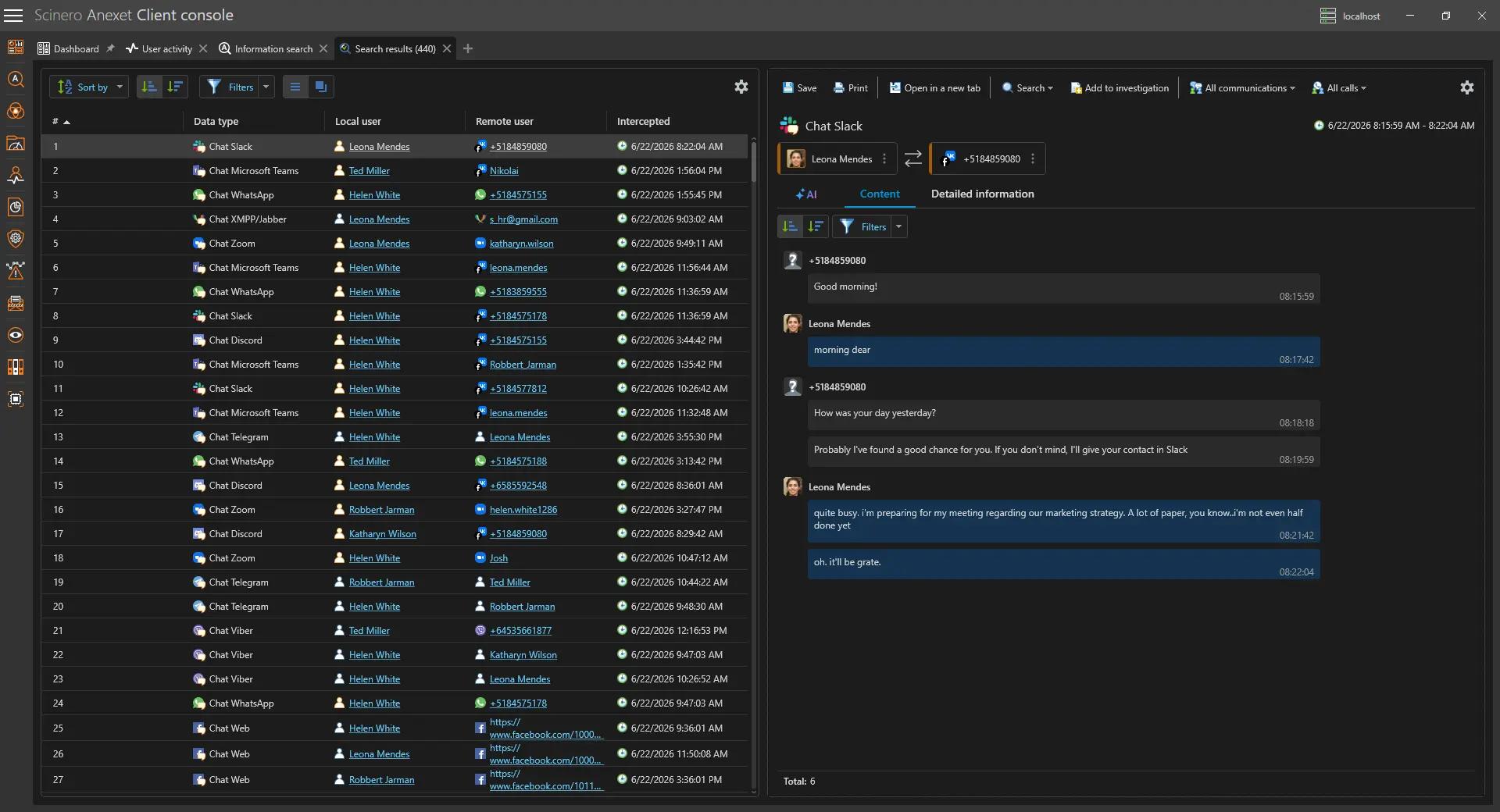
Anexet Client Console showing the Reports module and compliance dashboards

Built from Evidence, Stored Under Your Control

When an auditor asks what happened on a given date, your answer should come from a structured report — not from memory or a frantic search through raw logs.

Anexet's Reports module sits inside the Client Console and gives security officers, supervisors, and compliance leads a single place to build, review, and export structured documentation of everything the system has captured: who violated a policy and when, which channels carried the most traffic, how working time was distributed, and which users have triggered the most incidents.

Six report types cover this ground: a TOP report ranking users by an extreme metric, a Personnel (complete user) report for one individual, a Consolidated report summarizing multiple users, a Report on incidents comparing policy violations, a User activity report broken down by application or category, and a Timesheet tracking worked time per user and department — Timesheet gets a full walkthrough on its own dedicated page.

Reports can be built from pre-installed templates or assembled with the Report Wizard in minutes, with no technical expertise required.

Because Anexet is deployed on-premise, the underlying data never leaves your infrastructure. Every report — whether it goes to an internal audit file, a legal team, or a regulatory reviewer — is built entirely from data your organization controls, without any cloud processing step or vendor involvement.

Retention periods for report data are configurable per data type in the Administrator Console, so you can set how long records are kept based on your own business needs and compliance obligations rather than a fixed vendor default. Shorter retention windows also mean less data for the Report Server to index, reducing storage load. Setting retention limits by data type this way supports the storage-limitation principle that frameworks such as GDPR expect of the organization — Anexet gives you the control, not a certification.

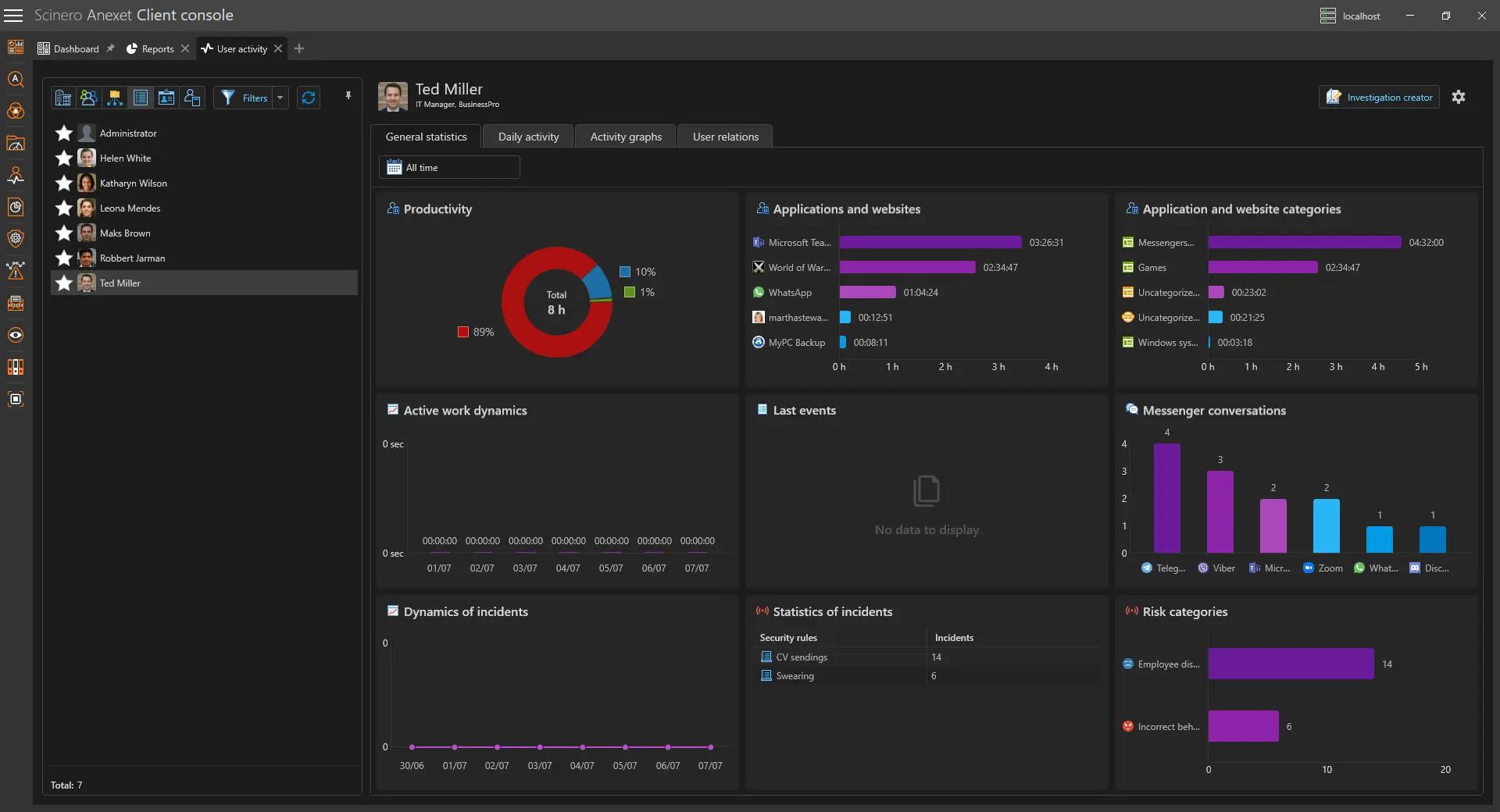
Reports on individual employees no longer require a separate trip to the Reports tree: from the Activity module's User Profile dashboard, a supervisor can select one or more users and generate a full report directly from their live activity view, alongside new productivity charts and a working-time visualization that break down how each person's day was actually spent.

Why it matters

  • Audit-ready documentation

    Pre-installed templates and the Report Wizard turn raw endpoint data into structured compliance documents in minutes, with no technical expertise required.

  • Your data, your infrastructure

    Every report is generated entirely on your servers — no cloud step, no vendor access, clear chain of custody for legal or regulatory review.

  • From summary to investigation

    Standard delivers periodic reports; Advanced adds real-time dashboards and instant alerts; Premium feeds risk scores and SIEM integrations.

What Anexet Reports and Measures

The following capabilities are available in the Reports module of the Client Console. The Report Center is included from the Standard plan.

Reporting tools

  • Pre-installed report library

    Standard

    A structured tree of ready-to-run reports grouped by category: activity, incidents, channels, working time, and more.

  • Custom reports

    Standard

    Build and save your own report definitions with user-defined parameters — time period, user group, channel, incident type.

  • Report Wizard

    Standard

    A step-by-step constructor for TOP reports and summary views — set the display period, number of users, and sorting type, then generate a chart or table in one click.

Incident & activity reports

  • Incident reports with severity levels

    Standard

    The Report on incidents breaks down policy violations by rule, with per-rule totals and a risk-statistics column for compliance reviewers.

  • TOP reports and Timesheet on working time

    Standard

    TOP reports rank employees by total active work time; the Timesheet report adds a calendar grid highlighting late arrivals and early departures against the work schedule, per user and department.

  • Activity and security dashboards

    Advanced

    Two configurable dashboard panels in the Client Console (Activity monitoring and Security control) built from drag-and-drop widgets — messenger message counts, productivity class breakdown, unproductive time top-lists, and more.

  • Incident alerts to a messenger

    Advanced

    When a security policy fires, Anexet sends an instant notification to the security officer's messenger so incidents do not wait for the next report cycle.

Data governance & access

  • Flexible data retention

    Configure retention intervals per data type in the Administrator Console under Saving Rules, keeping only what your business and compliance requirements call for and reducing storage load on the Report Server.

  • Role-based access control

    The Users and Privileges module grants or revokes access to Reports, Security Policies, Mail Quarantine, and Investigations per user group, so only authorized personnel can view or change sensitive data.

  • Report export

    Standard

    Save and export reports as audit evidence for internal reviews, legal proceedings, or regulatory submissions — supports frameworks such as GDPR, PCI DSS, ISO 27001, and HIPAA.

Risk Analysis feeds, the Investigations module for structured case management, and SIEM integration are available with the Premium plan.

On-Premise Reports — No Vendor in the Loop

Agents on monitored endpoints intercept traffic, user activity, and policy violations as they happen. The Report Server aggregates this data and maintains a live index visible in the Administrator Console — active days, users covered, last updated. Reports are then built inside the Client Console from that locally stored data, with no external calls required to generate or display them.

Because Anexet is deployed on your own servers, the vendor has no access to the intercepted data or to the reports derived from it. Chain-of-custody is maintained entirely within your infrastructure — a requirement for using report output as legal or regulatory evidence.

How long that data stays available is your decision: retention intervals are set per data type in the Administrator Console, so records older than your defined window age out automatically instead of accumulating indefinitely on the Report Server.

Anexet Client Console Reports module showing incident severity breakdown
Anexet security dashboard with activity monitoring and productivity widgets

How Security Reports Are Generated

Four steps from an intercepted event on the endpoint to a filed audit record.

Agents on monitored endpoints capture traffic, user activity, and policy violations continuously; the Report Server aggregates and indexes this data on your infrastructure.

1

Open the Reports module in the Client Console — the left panel shows a tree of pre-installed and custom report definitions; select a category or click Report Wizard to configure a new report.

2

Define the time period, user scope, and sorting; the Wizard generates a chart or table immediately — a horizontal bar chart for working-time TOP reports, a calendar grid for Timesheet, a tabular breakdown with a rule and risk column for incident reports.

3

Export the report to a file for audit records, legal review, or regulatory submission — generation and storage happen entirely on your servers, so chain-of-custody is maintained inside your infrastructure.

4

Agents on monitored endpoints capture traffic, user activity, and policy violations continuously; the Report Server aggregates and indexes this data on your infrastructure.

1

Open the Reports module in the Client Console — the left panel shows a tree of pre-installed and custom report definitions; select a category or click Report Wizard to configure a new report.

2

Define the time period, user scope, and sorting; the Wizard generates a chart or table immediately — a horizontal bar chart for working-time TOP reports, a calendar grid for Timesheet, a tabular breakdown with a rule and risk column for incident reports.

3

Export the report to a file for audit records, legal review, or regulatory submission — generation and storage happen entirely on your servers, so chain-of-custody is maintained inside your infrastructure.

4

Arrow

Reporting and Dashboards by Plan

StandardCore employee activity monitoring.
Network traffic interception
USB control
Printer monitoring
Messenger interception
Browser interception
and 4 more
Most popular
AdvancedAdds DLP and deeper visibility.
Standard plan included
DLP features
Network share monitoring
Keylogger
Webcam pictures
and 4 more
All-in-one
PremiumAll-in-one solution.
Standard + Advanced plans included
Advanced search (digital fingerprints, hash search)
File system monitoring
User relationship analysis
Risk analysis
and 6 more

Frequently Asked Questions

Common questions about Anexet's security compliance reports and activity dashboards.

What is a security compliance report in Anexet?

A security compliance report in Anexet is a structured document generated from intercepted endpoint data — covering policy violations, incident counts, channel activity, and working time across six report types: TOP report, Personnel report, Consolidated report, Report on incidents, User activity report, and Timesheet. Reports are built in the Client Console from pre-installed templates or via the Report Wizard, then exported as audit evidence for internal and regulatory review.

The Reports module — including pre-installed reports, custom reports, and the Report Wizard — is available from the Standard plan. Activity and security dashboards are added with the Advanced plan. Risk Analysis feeds and SIEM output require Premium.

Yes. Because all data is captured and stored on-premise within your infrastructure, reports come with a clear chain of custody. They are used as evidence in internal investigations, HR proceedings, and regulatory audits. Anexet helps you work toward frameworks such as GDPR, PCI DSS, ISO 27001, and HIPAA — it does not hold compliance certifications itself.

Yes. Anexet is deployed on-premise; the vendor has no access to your data.

No. Reports are generated entirely on your servers using data your agents have collected inside your network perimeter. Scinero Software Limited has no access to the intercepted data or to the reports derived from it.

Yes — from the Advanced plan, Anexet sends instant alerts to the security officer's messenger when a security policy fires. This is separate from the periodic report cycle and does not require logging into the Client Console to notice a new incident.

Anexet's Users and Privileges module grants or revokes access to Reports, Security Policies, Mail Quarantine, and Investigations per user group, so only authorized personnel can view sensitive incident data or modify policy configurations. Confirm exact role granularity for your deployment during the demo.

Yes — the Timesheet report shows total worked time, workdays, and a calendar grid highlighting late arrivals and early departures per user and department. It is available from the Standard plan; see the dedicated Timesheet page for the full breakdown.

Yes. Retention intervals are configurable per data type in the Administrator Console under Saving Rules, so you decide how long records stay available based on your own business and compliance needs rather than a fixed default — and shorter windows reduce the load on the Report Server. This gives you the storage-limitation control that frameworks such as GDPR expect; Anexet is not itself certified against any regulation.

Yes. The Activity module's User Profile dashboard lets a supervisor select one or more employees and generate a full report directly from their live activity view — the same dashboard also shows productivity charts and a working-time visualization for a quick read on how the day was spent.

Three professionals collaborating and looking at a tablet in a meeting

Get a Report Demo for Your Team

Tell us what compliance frameworks or audit requirements you are working toward — we will show you how Anexet's Reports module maps to your needs and arrange a demo or free trial of Anexet Ultimate.

I accept that my personal data can be processed in accordance with the Privacy Policy