


OCR, Stamp, Face & Speech Recognition for Security

Recognize text in images, stamps on scanned documents, faces in photos, and speech in recorded calls — all on-premise. Available on the Premium plan.

Schedule a Demo
Anexet Administrator Console showing recognition configuration

The Blind Spot Every DLP Has — Closed

Images and audio carry the same sensitive content as plain text — but most DLP tools cannot read them until OCR and speech recognition convert them to searchable text.

Every DLP deployment has a blind spot: data that arrives as an image. A contract scanned as a JPEG, a screen-grab of a confidential spreadsheet, a stamped approval document photographed on a phone — none of these are readable by keyword search until the image has been converted to text. The same gap exists in audio: a voice call recorded by the monitoring module carries no searchable content until someone transcribes it.

These gaps are exactly what Anexet's recognition capabilities close. The Image Recognition module — configured in the Administrator Console — teaches the system to read printed and handwritten text from intercepted images, detect whether a corporate stamp or seal appears on a document, and identify individuals by their face in captured photos. Speech Recognition completes the picture by transcribing intercepted audio recordings into searchable text, with voice identification to link a speaker to a known profile.

This capability set is relevant to information security teams handling internal investigations, to compliance officers who need to confirm that stamped approval workflows have not been bypassed, and to IT security managers responsible for ensuring that sensitive documents do not leave the organization regardless of the format in which they travel.

Why it matters

  • Images become searchable

    OCR converts intercepted scans, screenshots, and photos to machine-readable text — making them visible to keyword policies, thesaurus rules, and digital fingerprints.

  • Stamp forgery is detectable

    A configured stamp bank lets the system flag documents with unrecognized, missing, or forged corporate seals before they leave the organization.

  • Audio is as searchable as text

    Speech recognition transcribes recorded calls and VoIP sessions, and voice identification links the speaker to a known profile for investigations.

Five Recognition Capabilities, One Premium Module

All recognition capabilities below are available on the Premium plan only. They are configured in the Administrator Console and integrate with Information Search, Security Policies, and Investigations.

Image analysis

  • OCR — text in images and scans

    Premium

    Recognizes printed and handwritten text on intercepted images, screenshots, and scanned documents. Extracted text becomes searchable through Information Search and Complex Search — keyword queries, thesaurus rules, digital fingerprints, and hash comparisons all apply.

  • Stamp and seal recognition

    Premium

    Detects whether a corporate stamp or official seal appears on a document image. Administrators configure a stamp bank of reference samples; the system flags intercepted documents whose stamps match or fail to match entries in the bank.

  • Face recognition

    Premium

    Identifies individuals in intercepted images by comparing detected faces against a reference library. Useful in investigations when a person's identity needs to be confirmed from a photo sent through a monitored channel.

Audio analysis

  • Speech-to-text (Speech Recognition)

    Premium

    Transcribes intercepted audio recordings — calls captured via the Audio/Video Monitoring module, VoIP/SIP sessions, and recorded microphone audio — into searchable text stored alongside the original audio file in the Client Console.

  • Voice identification

    Premium

    Links a speaker's voice in a recording to a known voice profile, enabling investigations to attribute spoken content to a specific individual.

Recognition processing runs entirely on-premise within your own infrastructure. No images, audio files, or recognized content leave your perimeter.

On-Premise Recognition — No Vendor Access

Intercepted images and audio are passed to the recognition engine running within your organization's own infrastructure. OCR extracts text character by character; the stamp-recognition engine compares document images against the administrator-configured stamp bank; face recognition compares detected faces to the reference library; speech recognition transcribes audio to text. All extracted content is indexed alongside the original intercept record — the enriched record carries both the raw image or audio and its recognized text, with user, workstation, timestamp, and channel metadata.

Anexet is deployed on-premise; the vendor has no access to your data. All recognition processing — OCR, stamp matching, face comparison, and speech transcription — occurs inside your organization's infrastructure. No intercepts, images, audio files, or recognized content leave your perimeter.

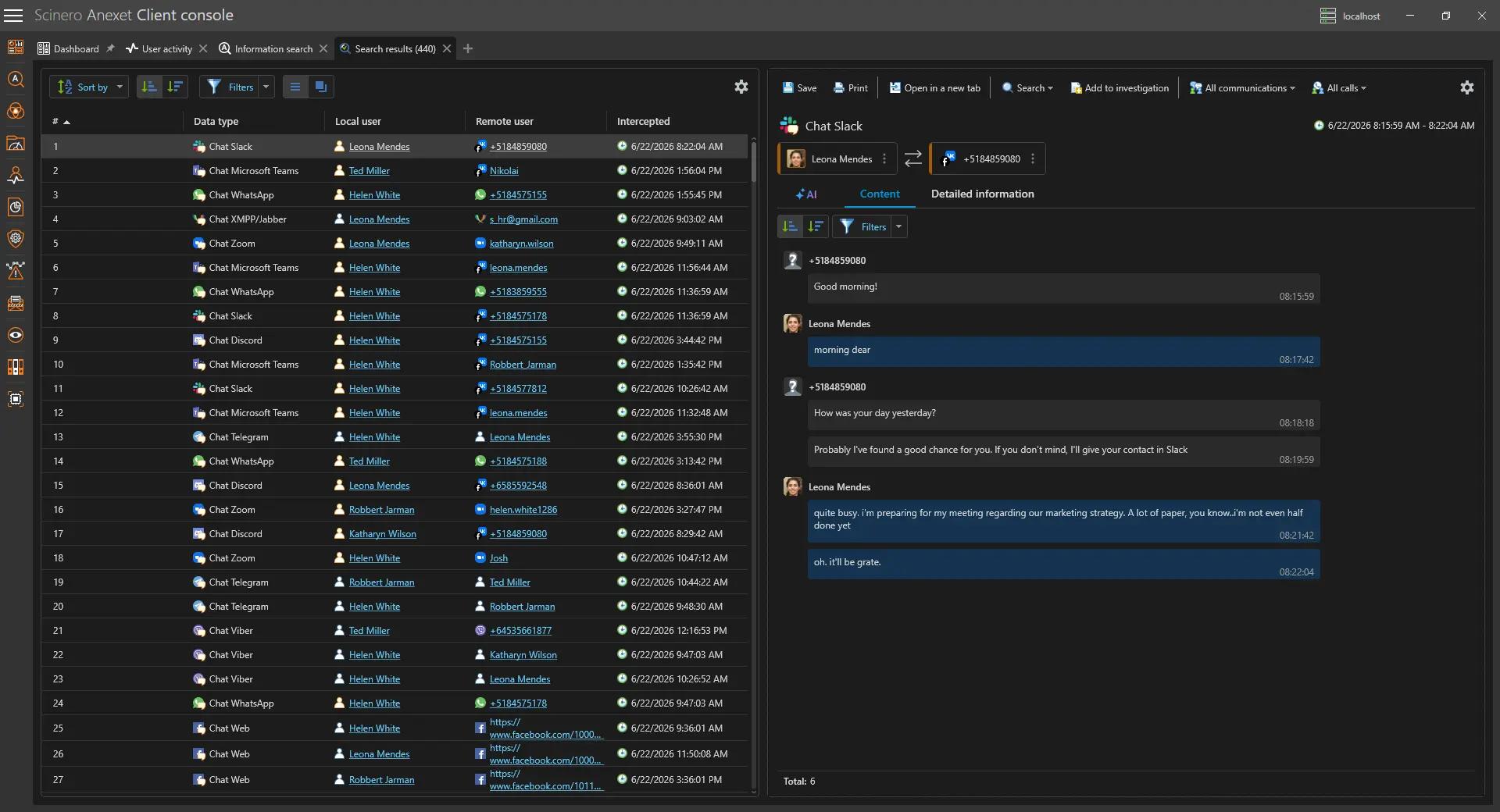
Intercepted document with OCR-extracted text in the Anexet Client Console
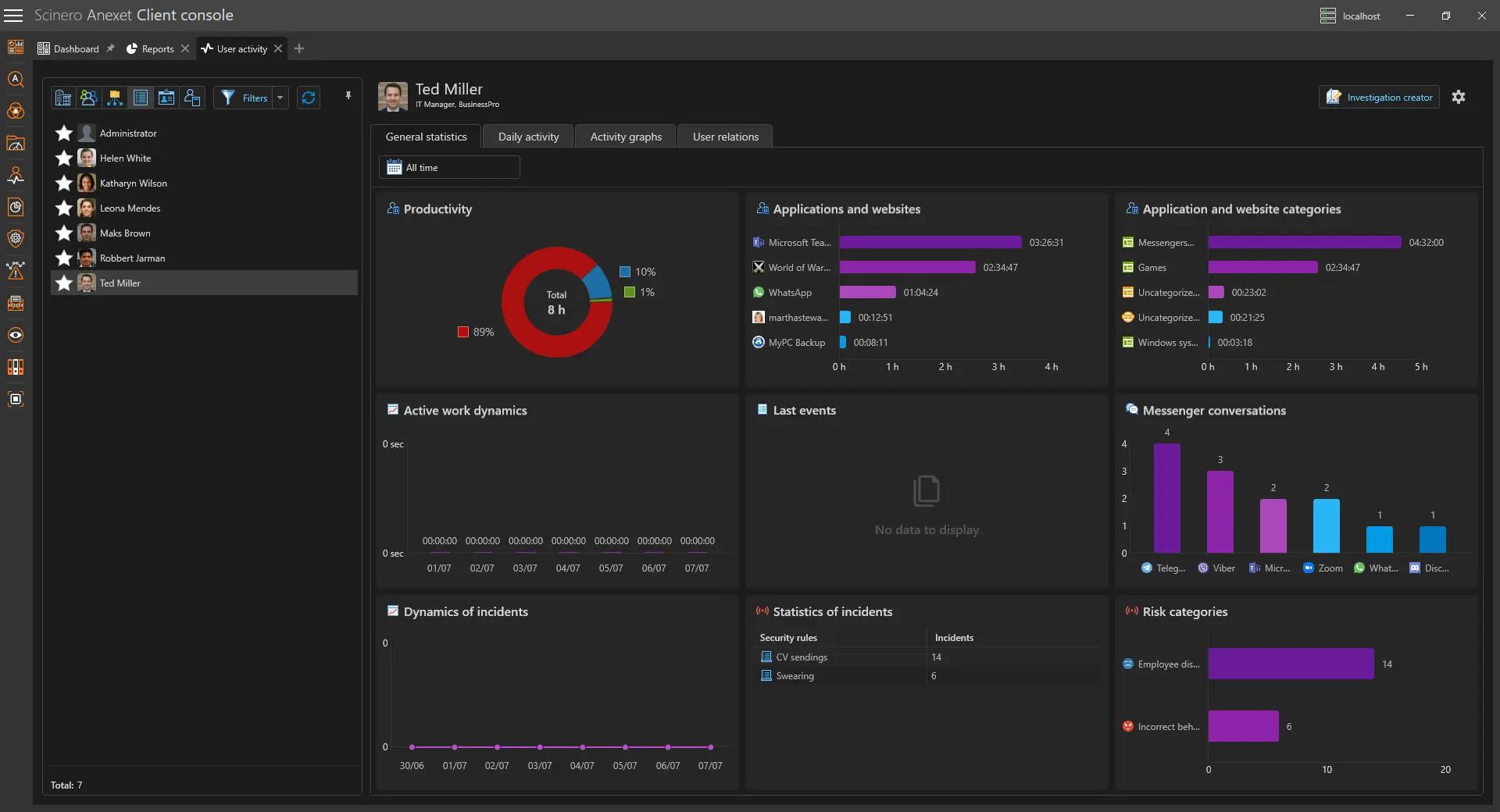
Recognition results and user activity in the Anexet Client Console

How Content Recognition Works

Four steps from a captured image or audio file to a searchable, policy-enabled record.

Agents on monitored endpoints capture images across channels — messenger attachments, email, cloud uploads, USB transfers, screenshots — and record audio via the Audio/Video Monitoring module.

1

Intercepted images and audio are passed to the on-premise recognition engine: OCR extracts text; the stamp engine compares against the stamp bank; face recognition checks the reference library; speech recognition transcribes audio.

2

Extracted text and recognition matches are indexed alongside the original intercept record, enriched with user, workstation, timestamp, channel, and any matched stamps or identified faces.

3

Security officers query recognized content in the Client Console using Information Search and Complex Search; Security Policies can trigger alerts when recognized content matches a rule — for example, a stamped document sent to an unauthorized recipient or a transcribed call containing prohibited phrases.

4

Agents on monitored endpoints capture images across channels — messenger attachments, email, cloud uploads, USB transfers, screenshots — and record audio via the Audio/Video Monitoring module.

1

Intercepted images and audio are passed to the on-premise recognition engine: OCR extracts text; the stamp engine compares against the stamp bank; face recognition checks the reference library; speech recognition transcribes audio.

2

Extracted text and recognition matches are indexed alongside the original intercept record, enriched with user, workstation, timestamp, channel, and any matched stamps or identified faces.

3

Security officers query recognized content in the Client Console using Information Search and Complex Search; Security Policies can trigger alerts when recognized content matches a rule — for example, a stamped document sent to an unauthorized recipient or a transcribed call containing prohibited phrases.

4

Arrow

Recognition by Plan

StandardCore employee activity monitoring.
Network traffic interception
USB control
Printers monitoring
Messengers interception
Browsers interception
and 4 more
Includes:
Anexet Activity
Most popular
AdvancedAdds DLP and deeper visibility.
Standard plan included
DLP features
Network shares monitoring
Keylogger
Webcam pictures
and 4 more
Includes:
Anexet DLP
Anexet Activity
All-in-one
PremiumAll-in-one solution.
Standard + Advanced plans included
Advanced search (digital fingerprints, hash search)
File systems monitoring
User relations analysis
Risk analysis
and 6 more
Includes:
Anexet DLP
Anexet Inventory
Anexet Activity
Anexet Ultimate

Frequently Asked Questions

Common questions about OCR, stamp recognition, face recognition, and speech-to-text in Anexet.

What does OCR recognition mean in a DLP context?

In a DLP context, OCR (optical character recognition) means that images and scanned documents intercepted by the system are automatically converted to machine-readable text. That text is then searchable, can be matched against keyword rules and thesauruses, and can trigger security policy alerts — exactly like any other intercepted text. Without OCR, an image of a confidential contract is invisible to content-aware policies.

A stamp bank is a library of reference images of corporate stamps and official seals, configured by the administrator in the Administrator Console. When the recognition engine processes an intercepted document image, it compares detected stamps against the bank. A match is recorded in the intercept record and can trigger a security policy alert. This is useful for detecting forged stamps or confirming that outgoing documents carry the correct approvals.

No. Face recognition in Anexet applies to still images intercepted through monitored channels — photos sent via messengers, email attachments, cloud uploads. It does not perform real-time video analysis of webcam feeds. Webcam snapshots captured by the Audio/Video Monitoring module can be processed if they contain faces, but this is an investigation tool, not continuous surveillance.

All recognition capabilities — OCR, stamp and seal recognition, face recognition, speech-to-text, and voice identification — are available on the Premium plan only. They are not available on Standard or Advanced.

Anexet is deployed on-premise; the vendor has no access to your data. All recognition processing — OCR, stamp matching, face comparison, and speech transcription — occurs within your organization's own infrastructure. No intercepts, images, audio files, or recognized content leave your perimeter.

Speech Recognition processes audio captured by Anexet's Audio/Video Monitoring module: microphone recordings, speaker recordings, and VoIP/SIP call recordings. It transcribes the audio to text, which is then stored as a searchable record alongside the original audio file. Voice identification links recognized speech to a specific speaker's voice profile. Both capabilities require the Premium plan.

Three professionals collaborating and looking at a tablet in a meeting

See Content Recognition in Action

Tell us which document types and audio channels you need to cover — we will show you how OCR, stamp recognition, and speech-to-text work in your environment during a free demo or a full trial of Anexet Ultimate.

I accept that my personal data can be processed in accordance with the Privacy Policy