Skip to content
Anexet
Product
Solutions
Features
Company
Services

System Consoles

Two consoles: the Client Console is where your security team works with data, the Administrator Console is where the system itself is managed.

Schedule a Demo
Client Console and Administrator Console on two monitors

Two Interfaces, Clear Responsibilities

Client Console

For security analysts and supervisors.

Working with intercepted data, setting up security policies, searching for information, and building reports — a set of modules in a single dark-themed workspace. Also runs on Linux workstations via Wine, with the same functionality as on Windows.

Administrator Console

For system administrators.

Configures the operation of all Anexet subsystems: Central Server, Data Processing Server, Users and Privileges Server, agents, recognition engines, and more. Runs on Windows and, through Wine, on Linux workstations, with the same full feature set on both.

Client Console: Daily Security Work in One Workspace

From information search and audio/video monitoring to risk analysis, blocking policies, and AI-powered incident summaries — every capability is a module, and your plan defines the set. A configurable User Profile dashboard brings a person's incidents, productivity, active processes and devices, and top sites and apps together in one real-time view, with audio and video monitoring launched right from it.

  • Complex Search

  • User Activity

  • Reports

  • Dashboard Panel

  • Audio-video Monitoring

  • Hardware and Software

  • File Systems Monitoring

  • Information Search

  • Investigations

  • Risk Analysis

  • Security Policies

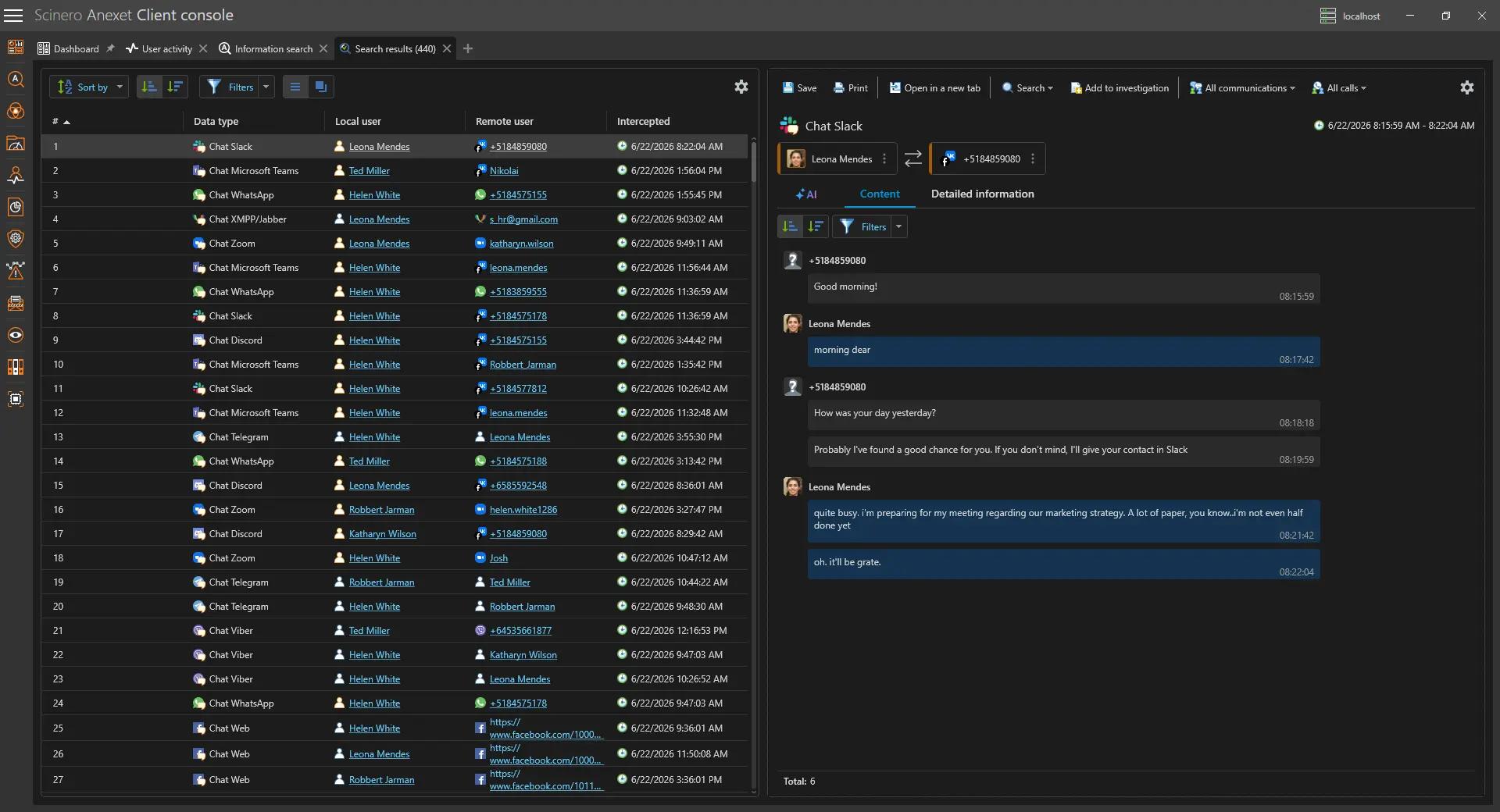
All communication channels in one view

Intercepted emails and messaging-app chats are read in a single interface: a message list with local and remote users, a full mail viewer with technical details, and chat conversations side by side.

Interception view with message list, email viewer, and messaging panel

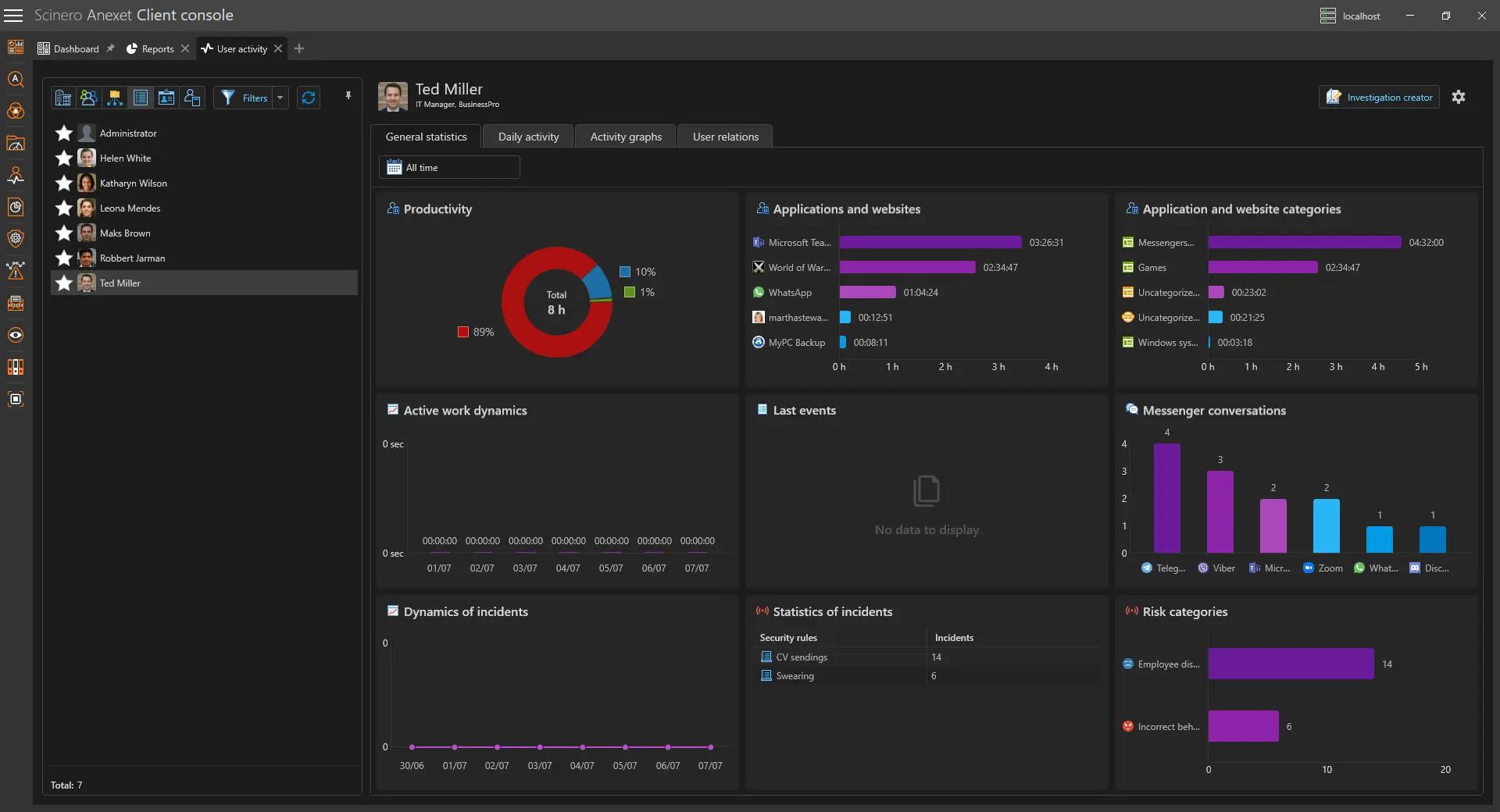
User Activity: a profile for every employee

A configurable User Profile dashboard per employee, updated in real time: incidents and recent events, productivity graphs, activity summaries, active processes and connected devices, top sites and applications, daily activity calendars, and relation graphs — with audio/video monitoring, detailed reports, and an investigation wizard launched straight from the profile.

User activity profile with daily activity calendar

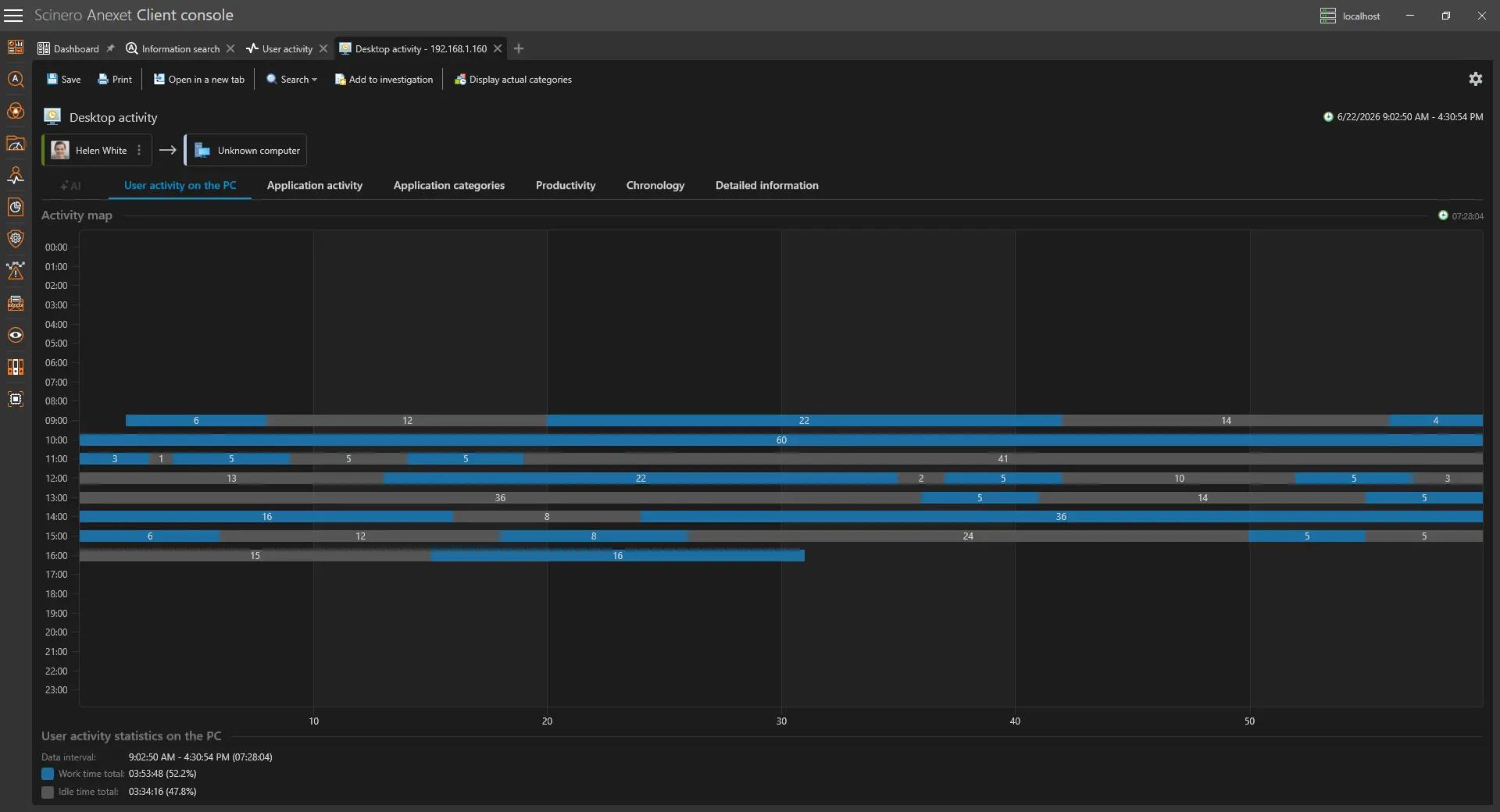
Desktop activity and productivity

Hour-by-hour activity timelines, application categories, and productive/neutral/unproductive time charts for any user or team.

Desktop activity timeline and user productivity donut chart

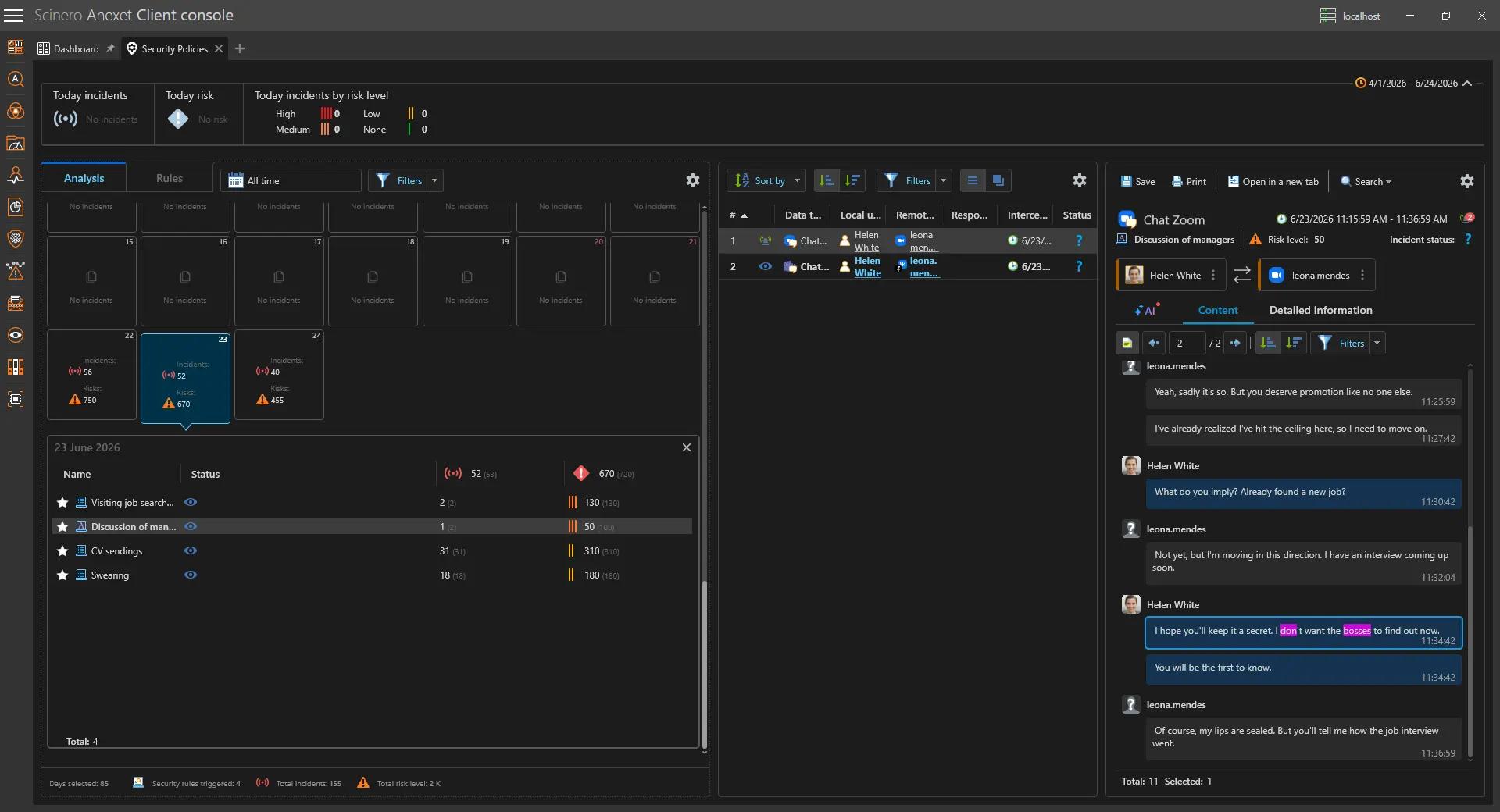
Risk analysis and security policies

Risk scores per employee, incident timelines, and a policy tree with risk levels and triggered-rule counters.

Risk analysis screen and security policies tree

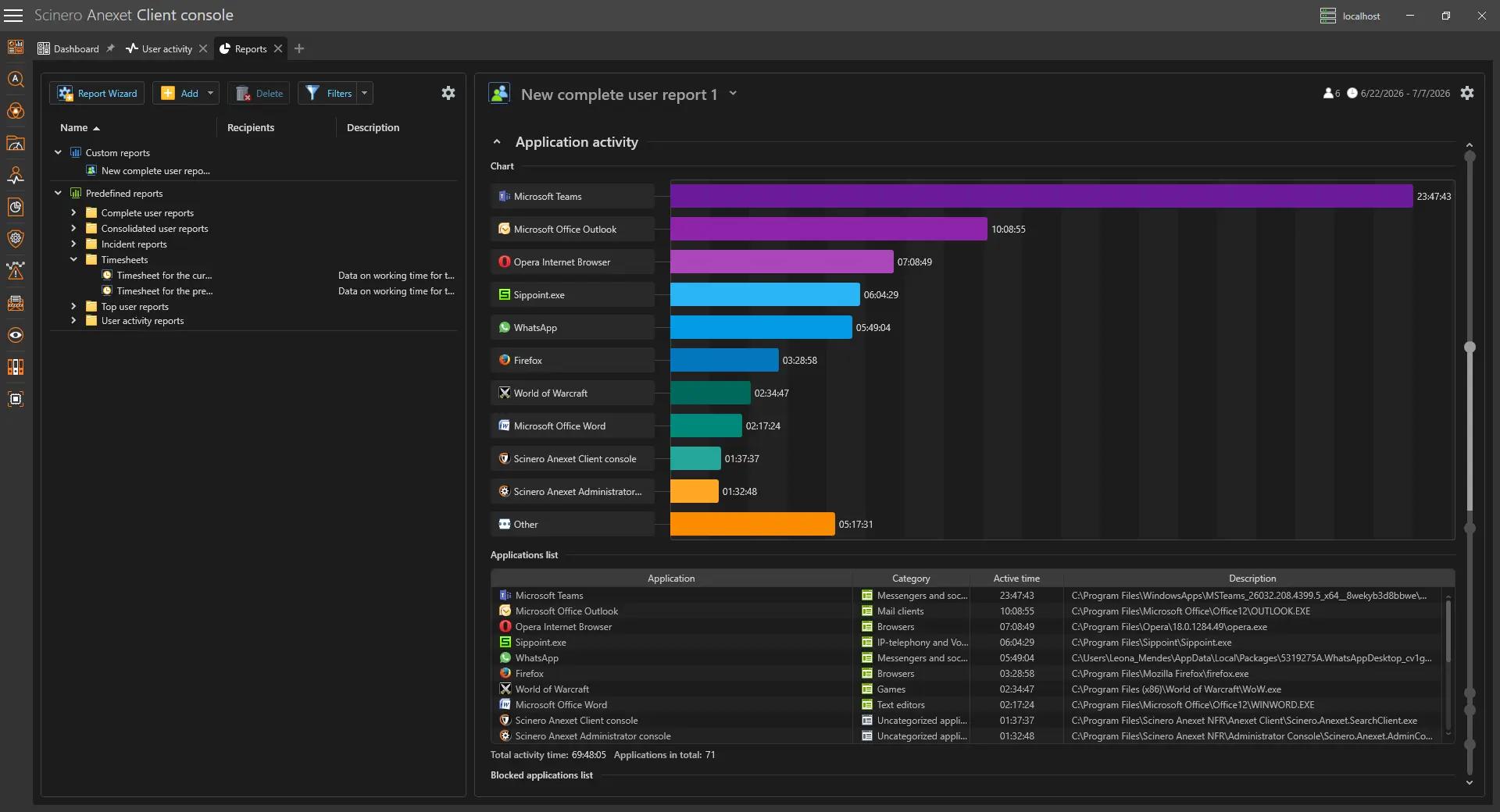
Reports in a few clicks

Preset and custom reports with a wizard: TOP reports by working time, incident reports by severity, and more.

Report wizard with TOP working time chart

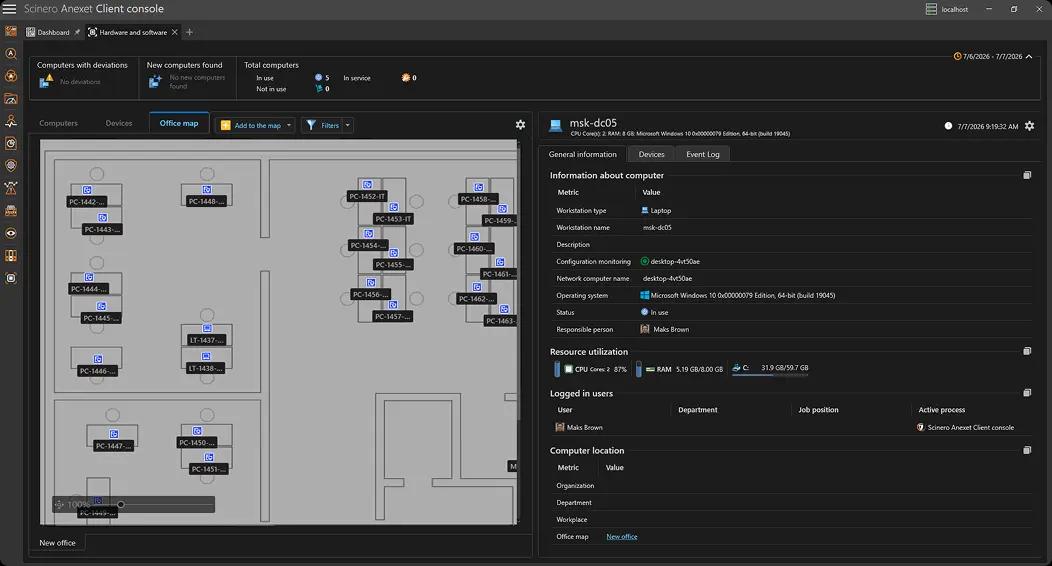
Hardware & Software at a glance

An office map with every computer in place, device cards with components and serial numbers, logged-in users, and resource utilization.

Office map and computer hardware card

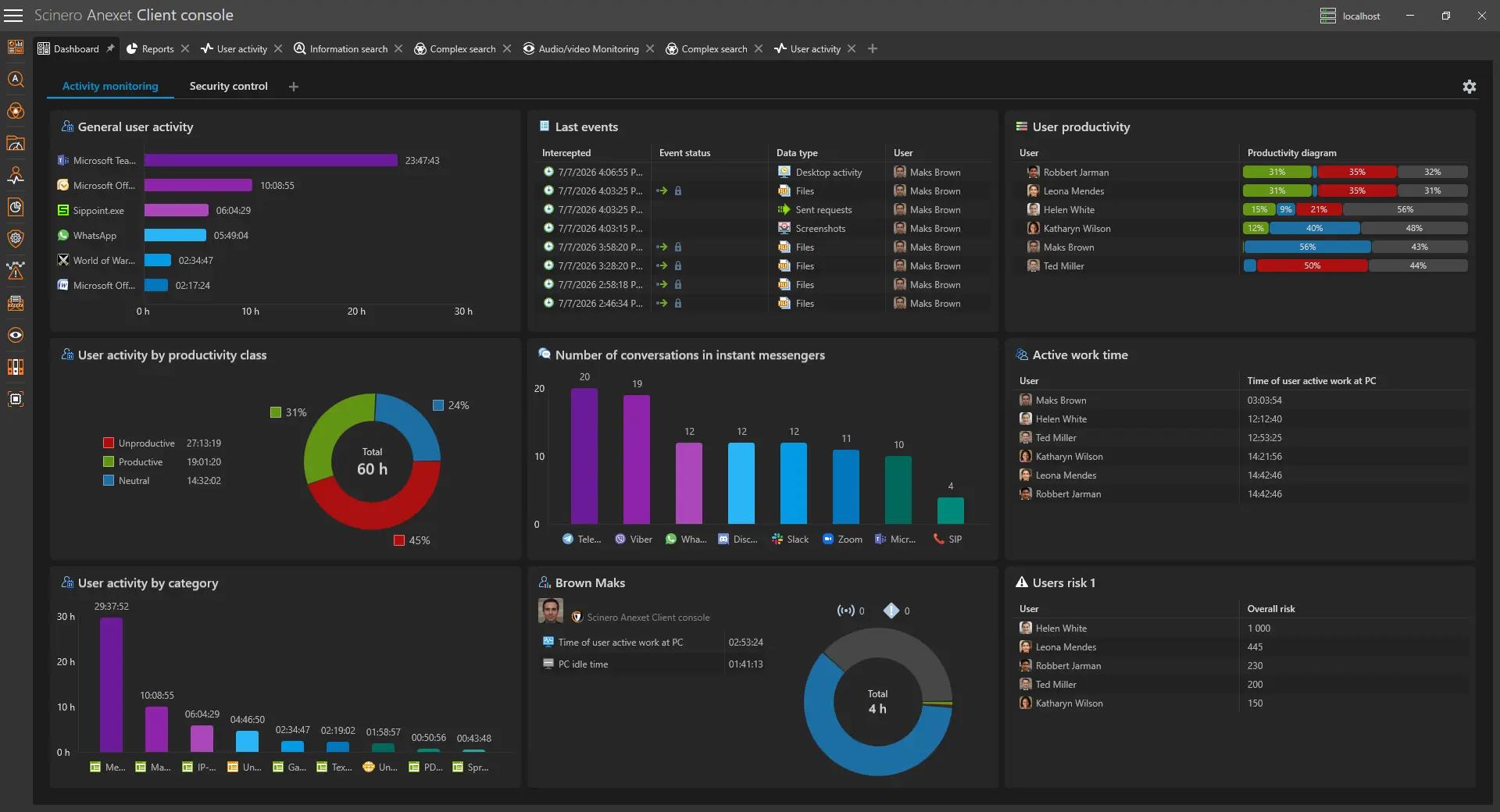
Dashboards for managers

Activity monitoring and security widgets: messaging apps, emails, active work time, productivity by class and category — all on one screen.

Dashboard with activity monitoring widgets
1/7

Administrator Console: Manage the Whole System

Sections cover everything from server status to notifications, agent rollout, and recognition engines:

  • Status Monitor

  • Central Server

  • Users and Privileges

  • Agents

  • Mail Processing

  • ICAP Server

  • Image Recognition

  • Speech Recognition

  • Reports

  • Security Policies

  • Event Log

  • Notifications Server

Inside the Administrator Console

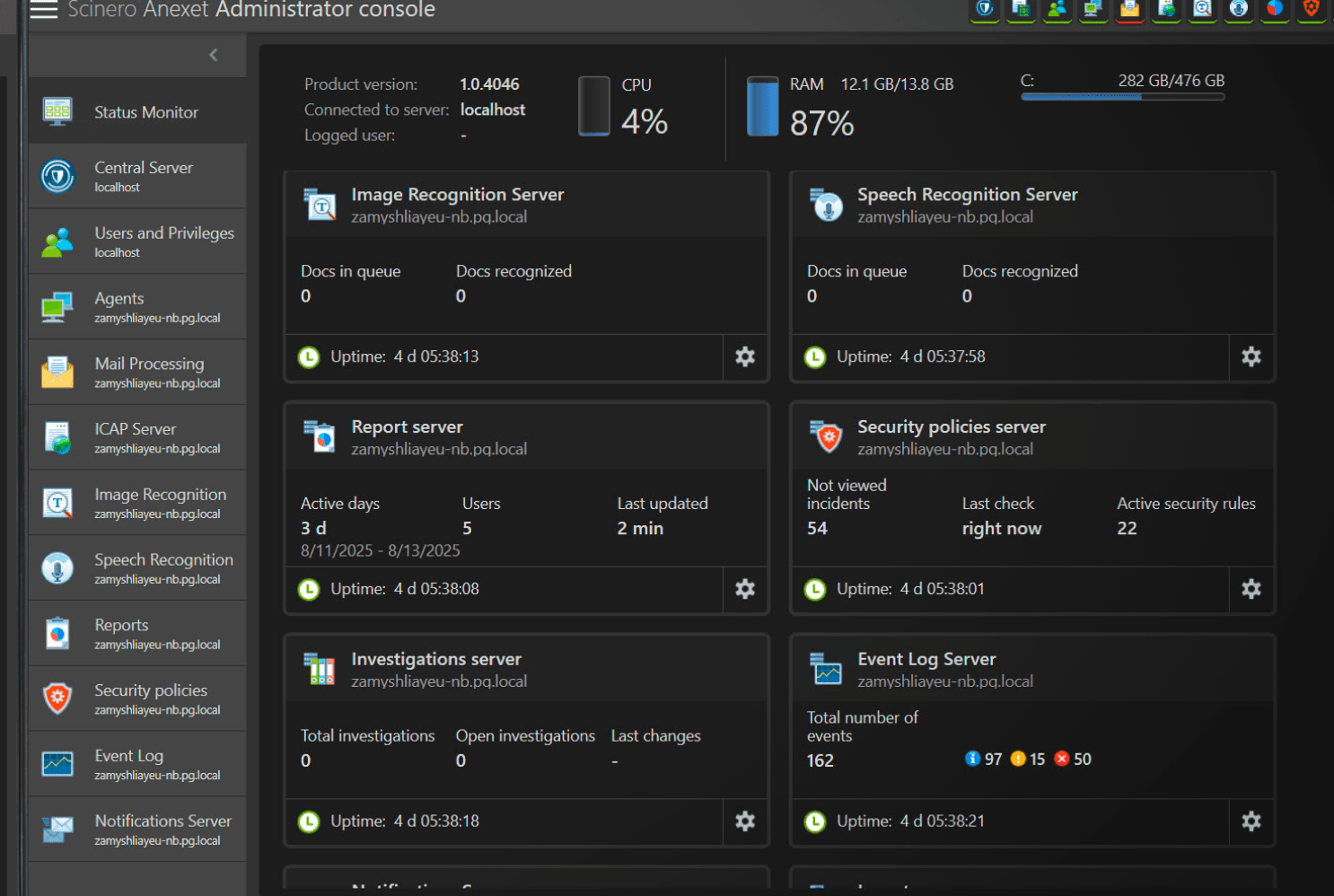
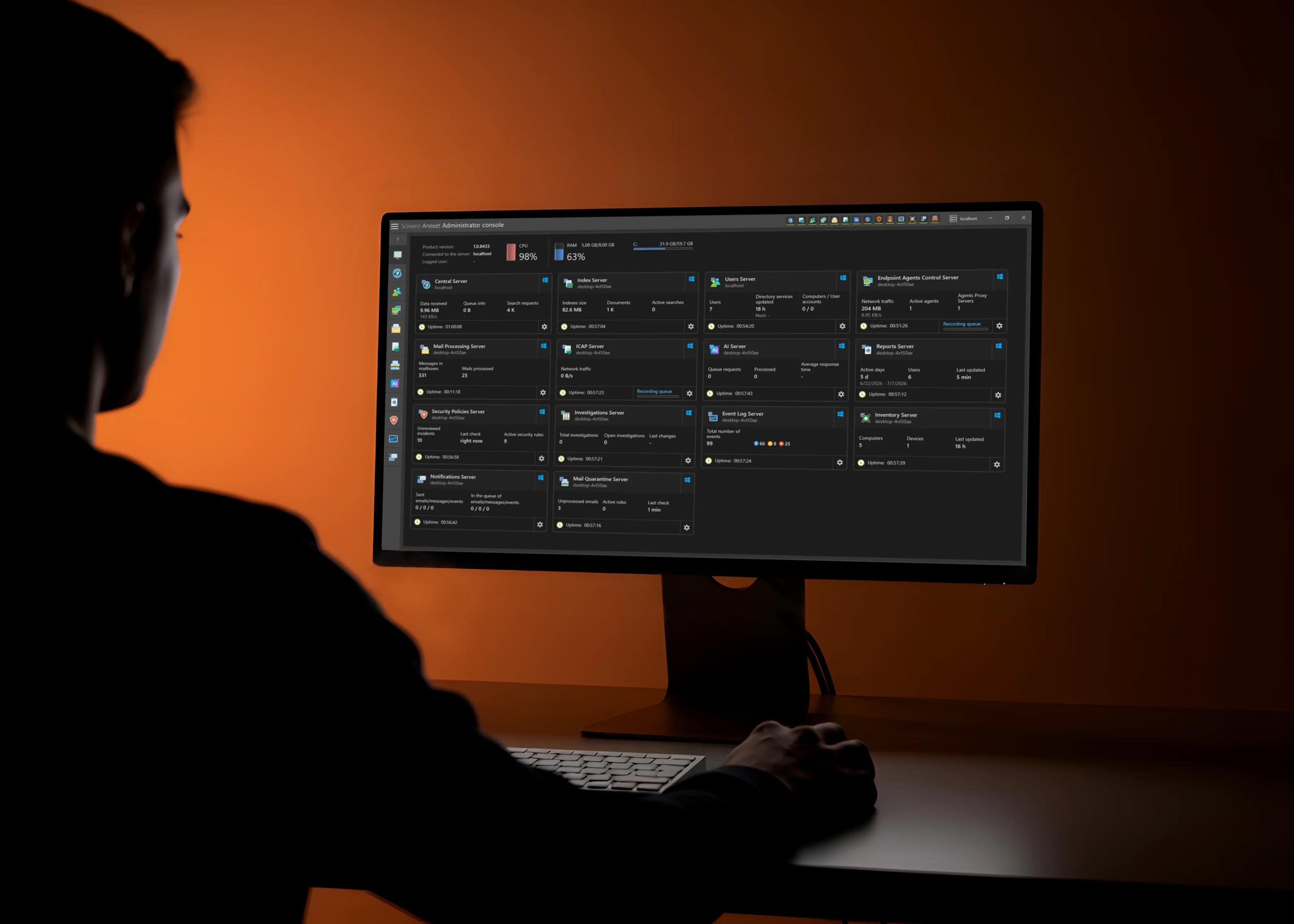
Status monitor with live server cards

Status Monitor

Live cards for every component: recognition queues, report server stats, security incidents awaiting review, investigations, event log totals — each with uptime, plus CPU, RAM, and disk usage of the host.

Agent deployment wizard and blocking rules tree

Agent deployment and blocking rules

A deployment strategy wizard rolls agents out to selected computers; blocking rules are managed in a clear tree by type.

Recognition settings with stamp template

Recognition engines

Switch on text, speech, face, and stamp recognition; upload stamp templates for document control.

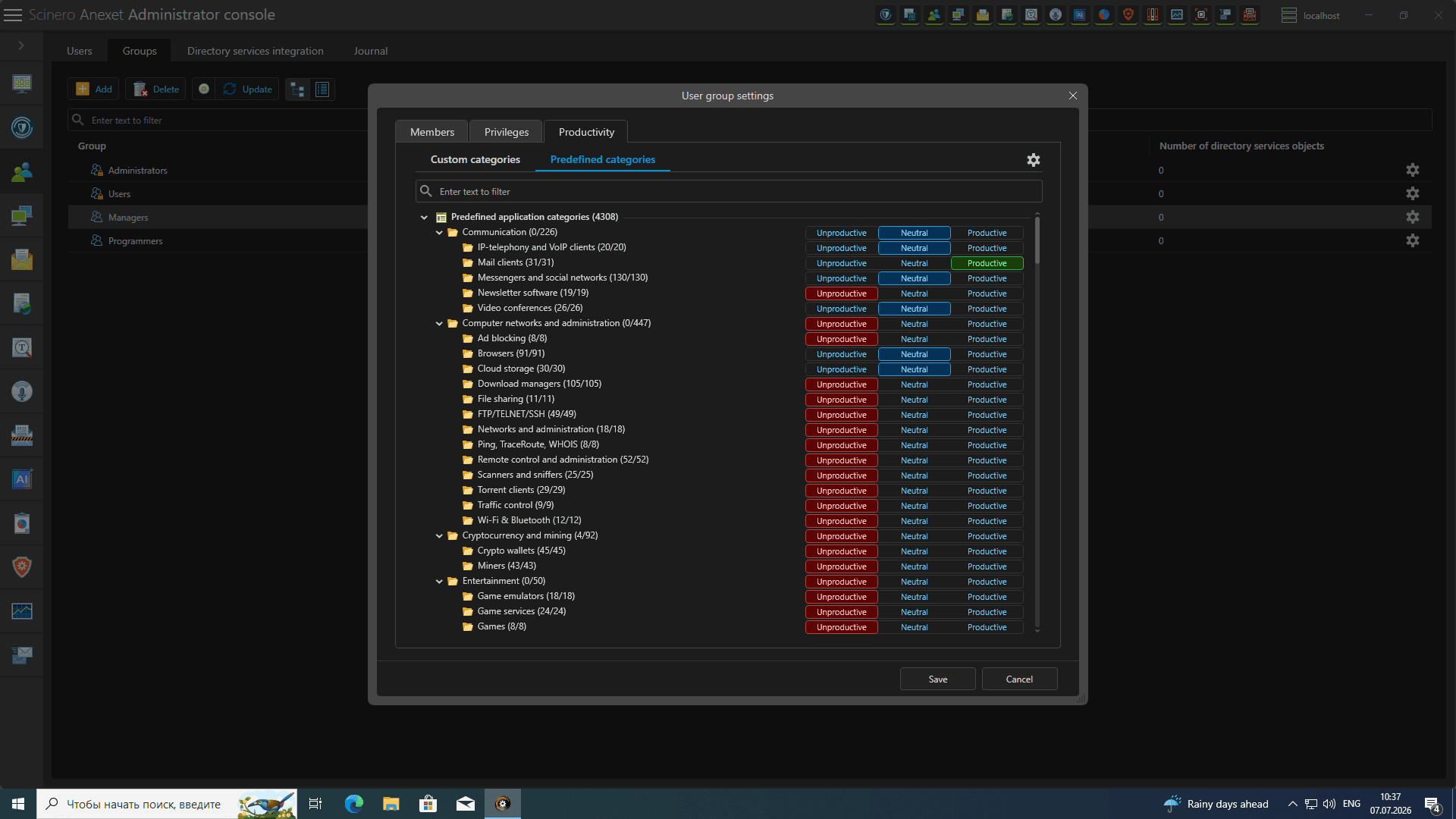
Predefined application categories with productivity labels

Productivity adjustment

Around 590 predefined application categories (messaging apps, VoIP, games, video conferencing, and more), each labeled productive, neutral, or unproductive — the basis for productivity analytics in the Client Console.

Module availability in the Client Console depends on your plan: Risk Analysis, Investigations, Hardware & Software, and recognition engines are part of Premium.

Frequently Asked Questions

Common questions about the Client and Administrator consoles, plans, and platforms.

Who uses which console?

Security analysts, supervisors, and managers work in the Client Console — with intercepted data, policies, reports, and investigations. System administrators use the Administrator Console to configure servers, deploy agents, and monitor system health.

Yes, both consoles come with every plan. What differs is the set of modules available inside the Client Console — for example, Risk Analysis and Hardware & Software appear with the Premium plan.

Yes. The Users and Privileges subsystem defines who sees what: access to security policies, risk analysis, and other modules is role-based, so analysts, supervisors, and administrators each work within their own scope.

The Client and Administrator consoles are desktop applications installed on the workstations of your security team and system administrators. They connect to your on-premise Anexet servers — no data leaves your perimeter.

The Users and Privileges section of the Administrator Console can connect to a directory service such as Active Directory to bring in your existing users and groups, so you don't have to recreate accounts manually.

Yes. Both the Client Console and the Administrator Console run on Linux workstations through Wine, with the same full functionality as the Windows versions — no feature is held back.

Incidents can be auto-assigned a status or filtered so alerts surface only potentially risky events, with multimodal AI models covering documents, correspondence, and other file formats. Administrators can add instructions and context to sharpen the analysis, and the console shows statistics on AI processing so you can track its results over time. Both cloud and on-premise models are supported.

Three professionals collaborating and looking at a tablet in a meeting

See the Consoles in Action

Book a guided session — we'll walk through both consoles on your use cases and set up a trial with full Ultimate functionality.

I accept that my personal data can be processed in accordance with the Privacy Policy