Insider Threat Detection & UEBA Risk Scoring

Anexet detects insider threats by continuously scoring each user's behavioral baseline and flagging statistical anomalies — unusual access patterns, sudden spikes in data movement, atypical working hours. The Risk Analysis engine runs on-premise inside your perimeter. Available on the Premium plan. Anexet is deployed on-premise; the vendor has no access to your data.

Schedule a Demo
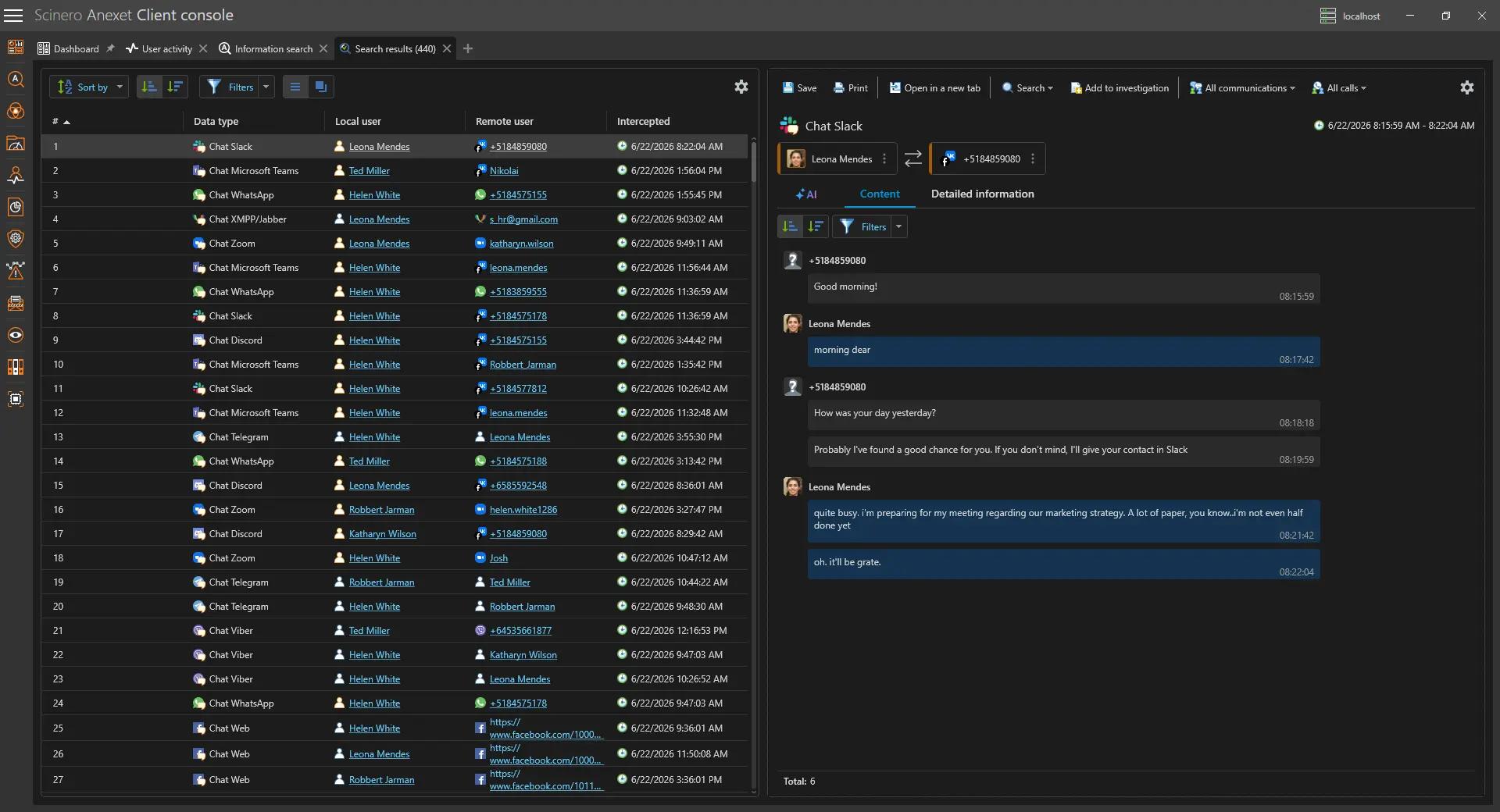
Anexet Client Console showing employee risk scores and behavioral anomaly alerts

The Threat That Already Has the Keys

Insider threats are hard to detect precisely because the actor has legitimate credentials — the malicious pattern is buried inside otherwise ordinary activity.

Perimeter firewalls catch outsiders. They do nothing about the employee who copies a customer database to a USB drive at 11 p.m. the week before resigning, or the contractor whose access rights were never revoked. Insider threats are hard to detect precisely because the actor has legitimate credentials — the malicious pattern is buried inside otherwise ordinary activity.

Security teams need a system that learns what 'normal' looks like for every individual, then surfaces deviations automatically. Not a wall. A lens.

Insider risk sits at the intersection of IT security and people management. IT-security professionals need hard evidence — timestamped events, a risk score, a behavioral timeline — to open an investigation and justify escalation. HR and line managers need context: is this person showing early warning signs? Is there a pattern across their communications, productivity, and data transfers that warrants a closer look?

Anexet bridges both audiences. The Risk Analysis module surfaces numeric risk scores and anomaly alerts to the security console. The employee dossier consolidates incidents, productivity signals, and active device information into a single dashboard that a manager can read without deep technical knowledge.

Why it matters

  • Behavioral baselines, not static rules

    Each user's risk score is built from their own history — deviations from that baseline trigger alerts automatically, without manual rule tuning.

  • Relationship graph reveals hidden patterns

    A visual map of every employee's connections to colleagues, external contacts, cloud storage, USB devices, and printers — derived from intercepted events, not org-chart data.

  • On-premise, no vendor access

    All behavioral baselines, risk scores, and employee dossiers are stored and processed inside your own infrastructure. The vendor has zero access.

What Anexet Detects and Captures

Behavioral risk scoring and the relationship graph are Premium-plan features. The employee dossier is available from Advanced. The underlying activity data is collected by the endpoint agent — silently, in the background, across Windows, Linux, and macOS.

Risk Analysis / UBA

  • Behavioral risk scoring

    Premium

    Each user receives a continuously updated risk score based on deviations from their own historical baseline. A cluster of deviations in a short window pushes the score above threshold.

  • Anomaly detection

    Premium

    Tracks statistical outliers: files accessed at unusual hours, data volumes that exceed a user's typical pattern, connections to new destinations, and correlated activity spikes.

  • Insider-threat indicators

    Premium

    Specific behavioral signatures — mass-exporting documents, repeated policy violations, elevated DLP incident counts — raise the risk profile automatically.

  • Alerts to the security team

    Premium

    When risk thresholds are crossed, instant notifications reach the responsible security officer, enabling rapid investigation before data leaves the organization.

Employee Relationship Graph

  • Visual communication map

    Premium

    A graph view plots each employee's connections to colleagues, external contacts, cloud storage, network shares, FTP servers, USB devices, and printers — derived from intercepted events.

  • Filter to violations only

    Premium

    The graph can be narrowed to show only channels where a policy violation or blocking event occurred, immediately highlighting the riskiest communication paths.

  • Cross-employee pattern analysis

    Premium

    When two or more users show an unusual connection pattern — a sudden increase in communications between an employee under review and an external address — the graph makes it visible.

Employee Dossier / Profile Dashboard

  • Unified view per person

    Advanced

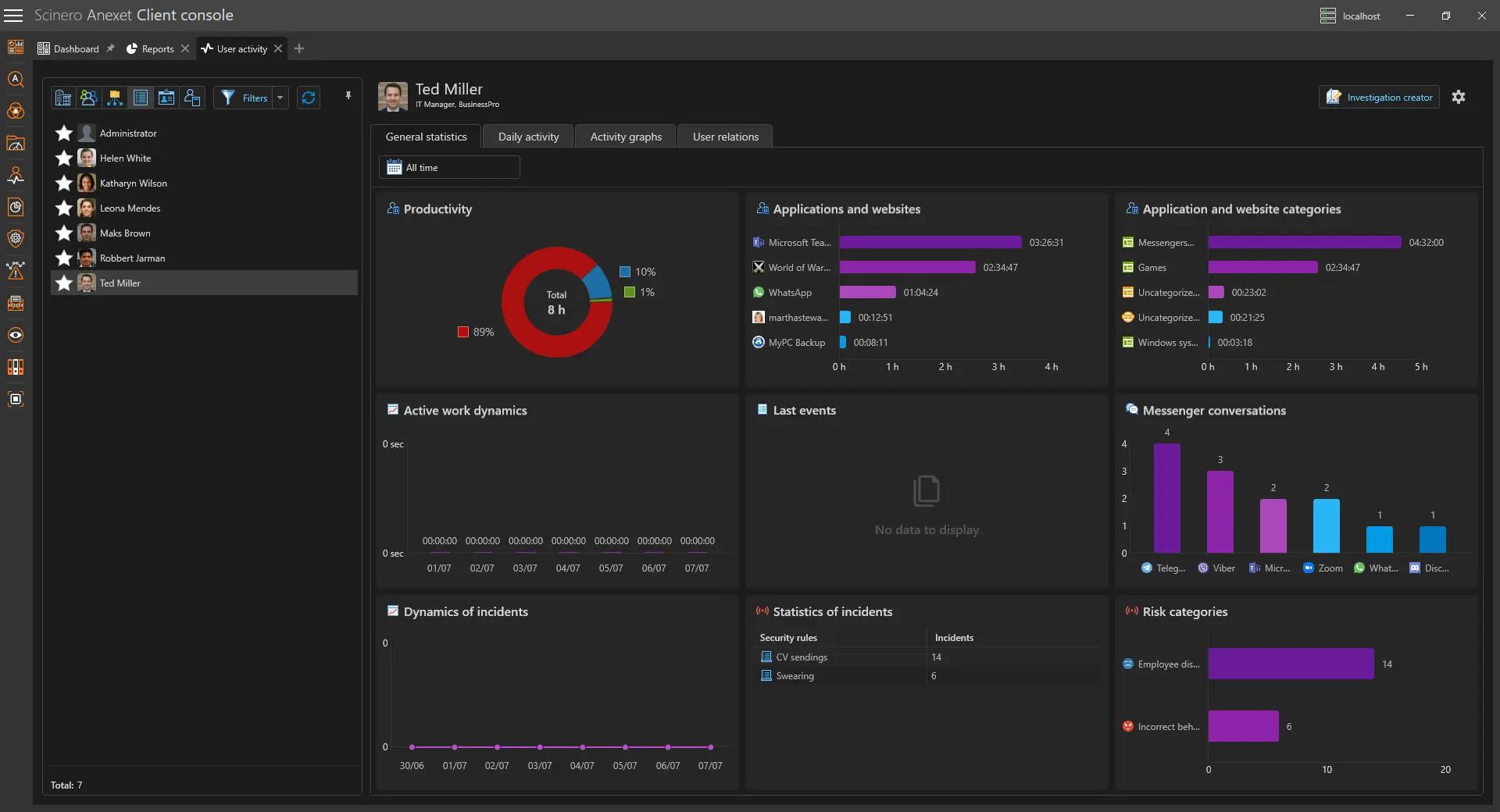
    A single screen shows recent incidents, DLP policy triggers, productivity metrics, active processes, and connected devices for any monitored user — refreshing in real time.

  • User tags

    Advanced

    Predefined and custom tags — 'preparing to resign,' 'under review,' 'elevated access' — are visible across all modules so context follows the user regardless of which screen is open.

  • Launch monitoring from the dossier

    Advanced

    Audio/video monitoring sessions and report generation can be initiated directly from the employee's profile page, without navigating to a separate module.

Risk Analysis / UBA and the employee relationship graph are Premium features. The employee dossier is available from Advanced. Our team confirms the exact capability set for your environment during the demo.

Evidence Collected on the Endpoint, Stored in Your Perimeter

A lightweight agent, deployed silently across endpoints, records application and browser usage, file operations, network activity, USB connections, DLP-channel events (mail, messengers, cloud, print), keystrokes (Advanced and above), and screenshots. All data flows to your on-premise server — no data leaves the corporate perimeter.

Anexet is deployed entirely on-premise. The vendor has no access to any data collected, processed, or stored by Anexet — not behavioral baselines, not risk scores, not employee dossiers. All processing happens inside your infrastructure, under your control.

Anexet Client Console showing a user's risk score timeline
Employee relationship graph in the Anexet security console

How Insider Threat Detection Works

Four steps from endpoint data collection to a controlled, investigation-ready risk record.

A lightweight agent on the workstation collects application usage, file operations, network activity, USB connections, DLP-channel events, keystrokes, and screenshots — silently, without impacting user performance.

1

All intercepted events are indexed and stored on the organization's own infrastructure — vendor has zero access; retention periods are configurable.

2

The Risk Analysis module continuously processes the event stream, builds per-user behavioral baselines, and applies anomaly-detection logic — scores update automatically without manual rule tuning.

3

When an alert fires, the security officer opens the employee dossier to review the full context — risk score, event timeline, relationship graph, recent DLP incidents — and can escalate, initiate closer monitoring, or export evidence for reporting.

4

A lightweight agent on the workstation collects application usage, file operations, network activity, USB connections, DLP-channel events, keystrokes, and screenshots — silently, without impacting user performance.

1

All intercepted events are indexed and stored on the organization's own infrastructure — vendor has zero access; retention periods are configurable.

2

The Risk Analysis module continuously processes the event stream, builds per-user behavioral baselines, and applies anomaly-detection logic — scores update automatically without manual rule tuning.

3

When an alert fires, the security officer opens the employee dossier to review the full context — risk score, event timeline, relationship graph, recent DLP incidents — and can escalate, initiate closer monitoring, or export evidence for reporting.

4

Arrow

Insider Threat Detection by Plan

StandardCore employee activity monitoring.
Network traffic interception
USB control
Printers monitoring
Messengers interception
Browsers interception
and 4 more
Includes:
Anexet Activity
Most popular
AdvancedAdds DLP and deeper visibility.
Standard plan included
DLP features
Network shares monitoring
Keylogger
Webcam pictures
and 4 more
Includes:
Anexet DLP
Anexet Activity
All-in-one
PremiumAll-in-one solution.
Standard + Advanced plans included
Advanced search (digital fingerprints, hash search)
File systems monitoring
User relations analysis
Risk analysis
and 6 more
Includes:
Anexet DLP
Anexet Inventory
Anexet Activity
Anexet Ultimate

Frequently Asked Questions

Common questions about how Anexet detects and investigates insider threats.

What is insider threat detection software?

Insider threat detection software monitors authorized users — employees, contractors, and administrators — to identify behavior that may signal malicious intent, negligence, or account compromise. It differs from perimeter security by focusing on what happens after someone is already inside the network: unusual data access, policy violations, or behavioral shifts that precede a leak or sabotage event.

Yes. Anexet is deployed on-premise; the vendor has no access to your data. All intercepted events, behavioral baselines, risk scores, and employee dossiers are stored and processed inside your own infrastructure. There is no cloud component that sends employee data to Scinero or any third party.

No. Scinero Software Limited has no access to any data collected, processed, or stored by Anexet. The system operates entirely within your corporate perimeter. This is a deliberate architectural choice, not a policy statement — the product has no telemetry channel back to the vendor.

Risk Analysis (UBA behavioral scoring, anomaly detection, insider-threat indicators) and the employee relationship graph are Premium-plan features. The employee dossier/profile dashboard is available from Advanced. Standard provides the underlying activity data but does not include automated risk scoring or the relationship graph.

Insider threat detection is a legitimate security practice when deployed under a clear policy that employees have been informed about. Security teams typically use these tools to investigate specific concerns rather than to conduct blanket surveillance. Because Anexet is on-premise and controlled entirely by the organization, the decision about what is monitored, who can see it, and how data is retained rests with the employer — not the vendor. Organizations should document their monitoring policy, obtain required consents under applicable law (GDPR, local labor law), and restrict console access to authorized personnel using the built-in RBAC controls.

When a user's behavioral risk score crosses the configured threshold, Anexet sends an instant notification to the responsible security officer. The officer can then open the employee's dossier to review the full context — the triggering events, the risk timeline, recent DLP incidents, and the relationship graph — and decide whether to escalate, initiate closer monitoring, or close the alert. All actions are logged.

Three professionals collaborating and looking at a tablet in a meeting

Detect Insider Threats Before Data Leaves

Tell us about your security posture and workforce size — we'll map the right plan and arrange a demo or a free trial of Anexet Ultimate.

I accept that my personal data can be processed in accordance with the Privacy Policy