Skip to content
Anexet
Product
Solutions
Features
Company
Services

Block Data Leaks to AI

Block employees from uploading files or pasting text into ChatGPT, Copilot, Gemini and other AI services. Group them into a category and control it as one.

Schedule a Demo
Anexet Client Console showing a blocked transfer to an AI web service

AI Tools Are the Newest Data-Leak Channel

Employees paste contracts into ChatGPT and upload spreadsheets to Gemini without realising data has just left the corporate perimeter.

Generative AI tools have become one of the fastest-growing data-leak channels inside organizations. An employee pastes a contract draft into ChatGPT, uploads a spreadsheet to Gemini, or asks Copilot to summarize a confidential strategy document — and sensitive data leaves the corporate perimeter in seconds, without any awareness that a violation is occurring.

Anexet addresses this through its Blocking Policies module (called Block data transmission in the product). A security officer groups the AI services to be controlled into a site category, then attaches HTTP(S), clipboard, and process blocking rules to that category. Rather than relying on employee awareness, the system intercepts the attempt at the network and process level before the data reaches the external service. When a rule fires, the transfer is stopped, the incident is logged in the Client Console, and the security team receives an alert. The employee sees a block notification; the data stays inside.

Because Anexet is deployed entirely on-premise, the blocking rules, intercepted data, and incident logs never leave your infrastructure. There is no cloud relay, no vendor processing pipeline, and no third-party visibility into what your organization is protecting.

Why it matters

  • Blocked before it leaves

    Interception happens at the network and process level on the endpoint — the data never reaches the AI service.

  • Incident logged and alerted

    Every blocked attempt is recorded in the Client Console with the employee, timestamp, channel, and the rule that fired.

  • On-premise, no vendor access

    All blocking rules, intercepted data, and incident logs remain inside your infrastructure — Scinero has no visibility into them.

What Anexet Blocks

The following blocking actions are available under the Blocking Policies module. Group any set of AI-service domains into a site category, then apply HTTP(S), clipboard, or process rules to that category — the exact setup for your target services is worked out together with the Scinero team during the demo.

Transfer blocking

  • File uploads to AI web services

    Advanced

    Groups ChatGPT, Copilot, Gemini, and other AI-service domains into a site category, then blocks HTTP(S) GET, POST, and PUT requests to that category — stopping file uploads before they leave the browser.

  • Text paste to AI chat interfaces

    Advanced

    A clipboard blocking rule scoped to the browser or app process intercepts copy/paste operations, preventing employees from pasting sensitive text into an AI prompt.

  • Centrally managed AI site category

    Advanced

    Security officers maintain the AI-service site category from one place — add or remove a domain once, and every HTTP(S), clipboard, and process rule that references the category updates automatically.

Access & app blocking

  • AI service web resource blocking

    Advanced

    An HTTP(S) blocking rule referencing the AI-service site category can control GET, POST, and PUT requests separately, preventing the browser from reaching those domains at all.

  • Desktop AI app blocking

    Advanced

    A process blocking rule identifies desktop AI applications by file name, path, hash, or metadata and blocks them from launching, not just their web versions.

  • Content-aware blocking

    Premium

    Fires only when the intercepted file or text matches a known sensitive object — digital fingerprints, hash banks, thesauri, or confidentiality labels. Allows AI use for non-sensitive work while blocking protected data.

All Blocking Policy rules require Advanced as the minimum plan. Content-aware blocking by digital fingerprints and hash banks is Premium-only. Anexet does not ship a pre-built list of AI-service domains — security officers build the site category during setup; ask the Scinero team about category templates for your deployment during the demo.

Blocked on the Endpoint, Logged in the Console

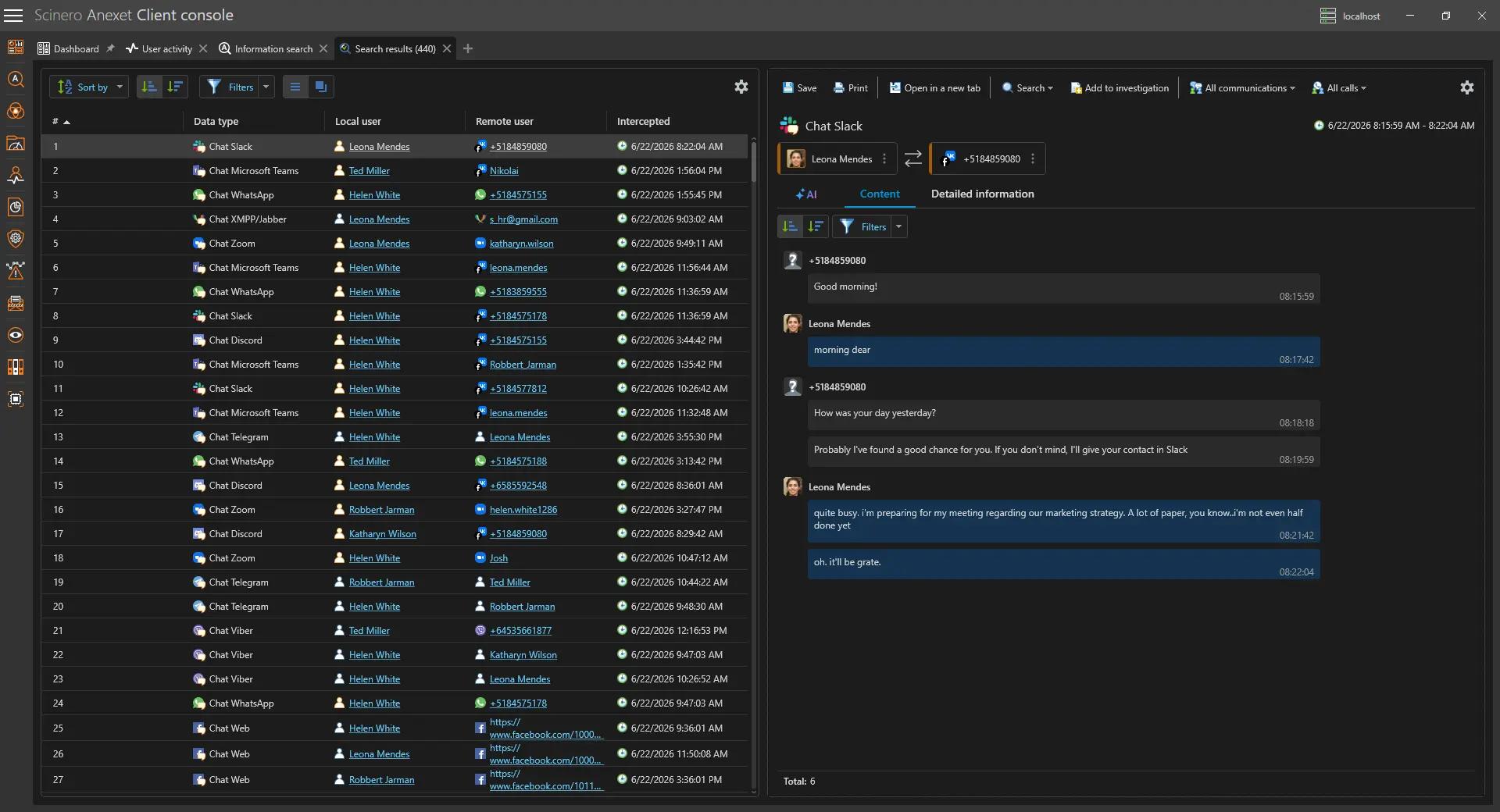
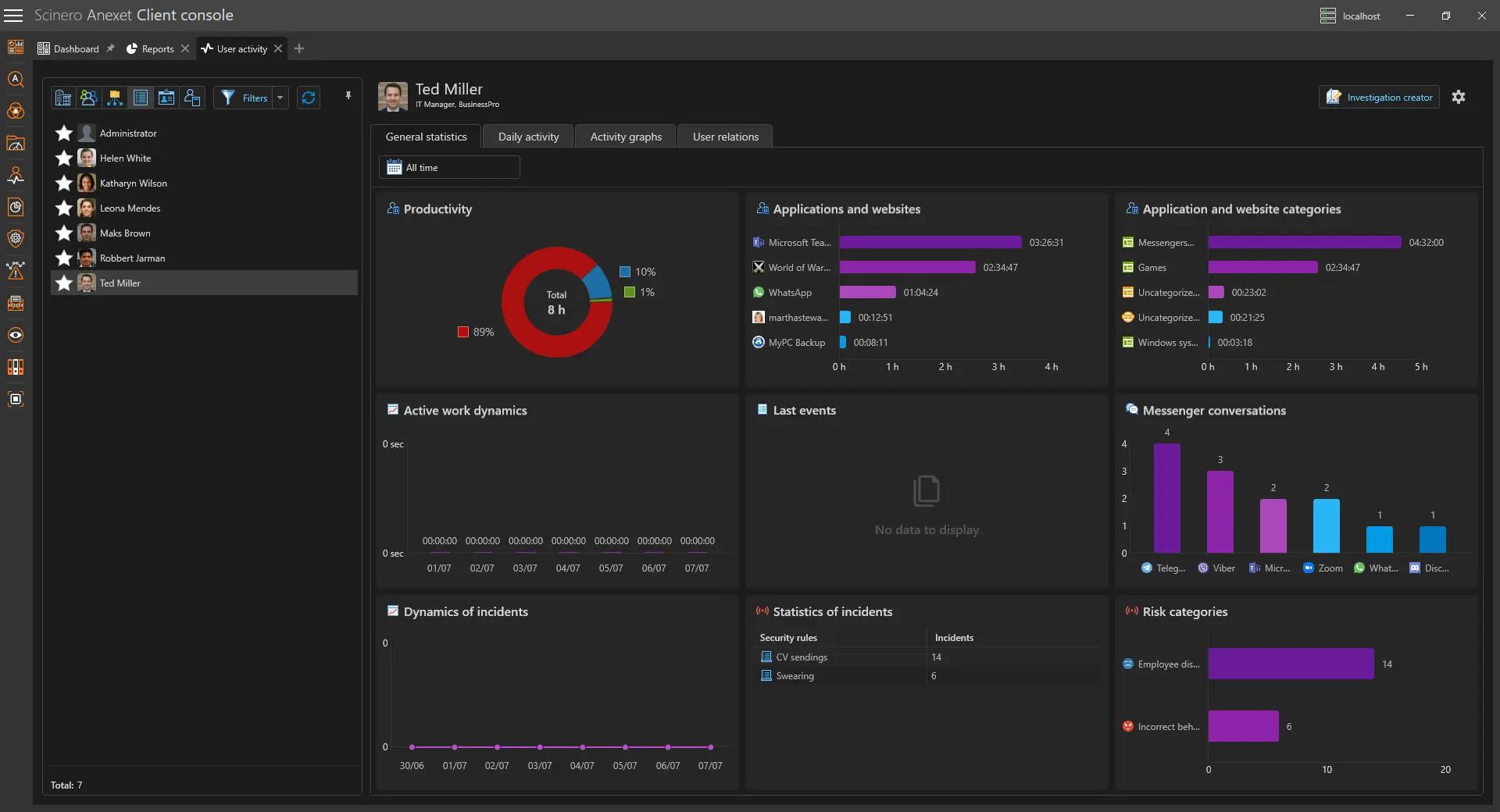
The Anexet agent on the employee's workstation intercepts outbound HTTP(S) traffic and clipboard activity in real time. When a Blocking Policy rule matches, the transfer is stopped immediately on the endpoint before the data reaches the external AI service. The incident is recorded in the Client Console with the employee's name, timestamp, channel, the data involved, and the rule that fired.

Blocking is enforced entirely on-premise, by the Anexet agent on the workstation and the servers your organization operates. No traffic passes through Scinero's infrastructure. In Premium deployments, incident records can be exported to a SIEM for correlation with other security events.

Blocking policy event recorded in the Anexet Client Console
User activity timeline showing a blocked AI upload attempt

How AI Leak Blocking Works

Four steps from an outbound attempt to a controlled, auditable record.

The Anexet agent on the workstation intercepts outbound HTTP(S) traffic and clipboard activity in real time, before the data reaches the external AI service.

1

The Blocking Policies engine compares the intercepted event against active rules — the custom AI-service site category, plus any clipboard or process rules layered on top.

2

When a rule matches, the transfer is stopped immediately. A blocking event is recorded in the Client Console with the employee, timestamp, channel, and the rule that fired.

3

The security team receives an instant alert. In Premium deployments, the incident record can be exported to a SIEM for correlation with other security events.

4

The Anexet agent on the workstation intercepts outbound HTTP(S) traffic and clipboard activity in real time, before the data reaches the external AI service.

1

The Blocking Policies engine compares the intercepted event against active rules — the custom AI-service site category, plus any clipboard or process rules layered on top.

2

When a rule matches, the transfer is stopped immediately. A blocking event is recorded in the Client Console with the employee, timestamp, channel, and the rule that fired.

3

The security team receives an instant alert. In Premium deployments, the incident record can be exported to a SIEM for correlation with other security events.

4

Arrow

AI Leak Blocking by Plan

StandardCore employee activity monitoring.
Network traffic interception
USB control
Printer monitoring
Messenger interception
Browser interception
and 4 more
Most popular
AdvancedAdds DLP and deeper visibility.
Standard plan included
DLP features
Network share monitoring
Keylogger
Webcam pictures
and 4 more
All-in-one
PremiumAll-in-one solution.
Standard + Advanced plans included
Advanced search (digital fingerprints, hash search)
File system monitoring
User relationship analysis
Risk analysis
and 6 more

Frequently Asked Questions

Common questions about blocking data leaks to AI tools with Anexet.

Can Anexet block employees from using ChatGPT at work?

Yes. Using Anexet's Blocking Policies module, you group ChatGPT and any other AI service into a custom site category, then apply HTTP(S) rules to block file uploads and text transfers, or block the domain outright at the process level so the browser cannot reach it at all. This capability is available from the Advanced plan; the exact setup for your target services is worked out with the Scinero team during the demo.

No out-of-the-box list is published in the product documentation. You build a custom site category listing the AI services you want to control — ChatGPT, Copilot, Gemini, or any other — and apply one set of blocking rules to the whole category. Ask the Scinero team during the demo about any category templates available for your deployment.

Blocking is enforced entirely on-premise, by the Anexet agent on the employee's workstation and the servers you operate. No traffic passes through Scinero's infrastructure. Anexet is deployed on-premise; the vendor has no access to your data.

Blocking Policies are available from the Advanced plan and included in Premium. The Standard plan includes interception and logging but does not include blocking.

Yes, in the Premium plan. Content-aware blocking using digital fingerprints, hash banks, thesauri, and confidentiality labels fires only when the intercepted file or text matches a known sensitive object. This allows employees to use AI tools for non-sensitive work while blocking transfers that involve protected data.

Yes. Agents run on Windows, Linux, and macOS including ARM64. Blocking policies apply across all supported platforms. Server components run in a Linux environment. No mobile agents are available.

Three professionals collaborating and looking at a tablet in a meeting

Stop AI Data Leaks Before They Start

Tell us which AI tools your teams use and which data you need to protect — we'll map it to the right plan and arrange a demo or a free trial of Anexet Ultimate.

I accept that my personal data can be processed in accordance with the Privacy Policy