


Categories
SOC and Information Security
 23
23 12 min
With cyber threats on the rise, companies need an effective tool to monitor and manage enterprise cybersecurity. The Security Operations Centre, or SOC, used by enterprises to protect their data and infrastructure, can be such a tool. With a SOC, organisations can take holistic approach to Information Security, identify potential attacks in timely manner and minimise their impact on the enterprise. Let's explore this topic together.
SOC is not anonymised software, but the complex of interconnected tools used and managed by a close-knit team of cybersecurity experts. The main advantage of a SOC is people's expertise working in this unit, on the basis of which the enterprise can make decisions on the development of an Information System. In fact, SOC can have different names: Cybersecurity Control Centre, Security Operations Centre and others. The main thing is that this structural unit performs all the main functions of managing the enterprise's Information Security Systems.
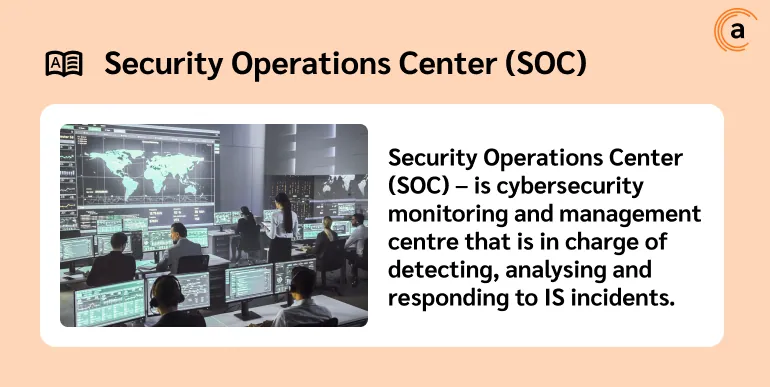
Main functions of the Security Operations Center (SOC)
Let's take a look at the basic functions of SOC.
Firstly, it is monitoring and analysing security events. SOC staff must provide constant visibility of network activity in order to detect abnormal behaviour of both outside objects and objects in the internal security loop of the enterprise. The most commonly used systems for event monitoring and analysis are event and information management systems such as SIEM systems, Network Detection and Response (NDR) network traffic monitoring systems, EDR/XDR endpoint threat tracking and response systems (personal computers, enterprise servers), SOAR automated incident handling systems, IDS/IPS network traffic analysis systems for attack, anomaly and intrusion detection, Threat Intelligence Platforms (TIP), Threat Intelligence Platforms (TIP), Threat Intelligence Platforms (TIP), Threat Intelligence Platforms (TIP), Threat Intelligence Platforms (TIP), Threat Intelligence Platforms (TIP), Threat Intelligence Platforms (TIP), Threat Intelligence Platforms (TIP), and Threat Intelligence Platforms (TIP).
Second, SOC is used to detect and respond to Information Security incidents, analyse threats and promptly remediate discovered vulnerabilities. Cybersecurity department employees with help of SOC complex can determine the source and scope of an incident, assess the level of risk and potential consequences, decide on response measures and eliminate attack.
Third, SOC includes vulnerability and threat management process. This is process of identifying weaknesses in the system and their elimination to ensure further Information Security of the enterprise. As a rule, it is divided into several stages: the stage of creating a database of information assets, the stage of identifying the weaknesses of the system, the assessment and prioritisation of identified threats, the stage of eliminating problems, and further monitoring and analysis.
Fourth, Information Security incident investigation activities and digital forensics. As part of this stage, a team of specialists working in the company investigates the causes and consequences of already identified Information Security incidents, collects and analyses the data obtained to minimise similar threats in the future.
Fifth, is involved in providing support for compliance with legal requirements and security standards. For example, compliance with the regulatory requirements of ISO 27001/2022: Information Security, Cybersecurity and Privacy Protection — Information Security Management Systems.
SOC components
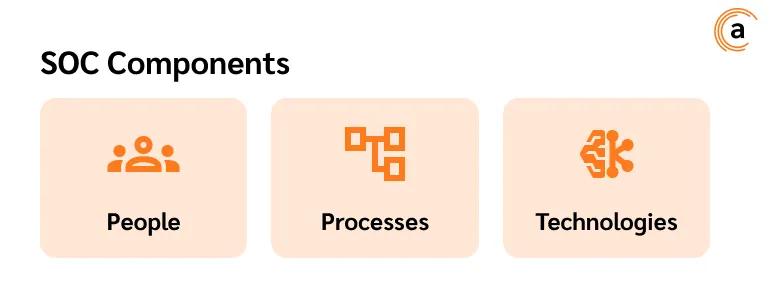
A cybersecurity monitoring and control centre SOC consists of three main components: people, process and technology.
-
People as the key link in all operations and activities to manage the processes and technologies used to ensure Information Security. This includes enterprise cyber security specialists, analysts, engineers, incident responders, etc.
-
Processes — as all standardised procedures for responding to Information Security events (auditing, update and access management, security policies, incident response plans, etc.).
-
Technology — all the tools used to ensure security of information in the enterprise, both on the external and internal security loop. This includes UEBA, SIEM systems, IDS/IPS, DLP systems, EDR and other elements.
Types of SOC
There are three main types of SOCs:
- internal SOC (In-house). An enterprise security centre created and used within a company, providing full control over information resources. In-house SOC is characterised by the consumption of significant financial and labour resources, as well as full responsibility on the company's employees;
- external SOC (MSSP or Managed Security Service Provider). This is outsourcing model in which SOC services are provided by a specialised company hired by the main company. This is the compromise option where the company does not deal with Information Security directly, but utilises the resources and expertise of invited service providers;
- external SOC (MSSP or Managed Security Service Provider). This is outsourcing model in which SOC services are provided by a specialised company hired by the main company. This is the compromise option where the company does not deal with Information Security directly, but utilises the resources and expertise of invited service providers.
Role of DLP system in SOC
DLP systems play a key role in the work of the Security Operations Centre. It is thanks to this programme complex that the prevention of confidential data leaks within the corporate network is ensured. DLP-systems control the transfer of information within the enterprise, detect abnormal user behaviour and help minimise risks associated with data leaks due to any of the reasons: insider activity, inattention or employee errors, deliberate destruction or modification of data.
The basic principle of DLP systems is analysing and controlling the flow of data within a company. This is achieved by tracking as many data paths as possible, including email, messengers, social networks, audio and video communication, through external drives and cloud storage.
An important advantage of DLP systems is also their availability and ability to integrate with other SOC tools. This allows security event analytics to be combined, improving the overall effectiveness of the defences in place. With this integration, you can respond to incidents faster, identify insider threats and automate incident investigations using digital forensics.
SOC includes vulnerability and threat management: identifying security weaknesses and remediating them to ensure company resilience. DLP systems, in turn, play important role in this process due to their ability to investigate recorded IS incidents. Using Anexet Ultimate as an example, investigations can utilise detailed event logs, user activity analytics, visual dashboards and tools useful in digital forensics. There is even a separate module dedicated to investigations.
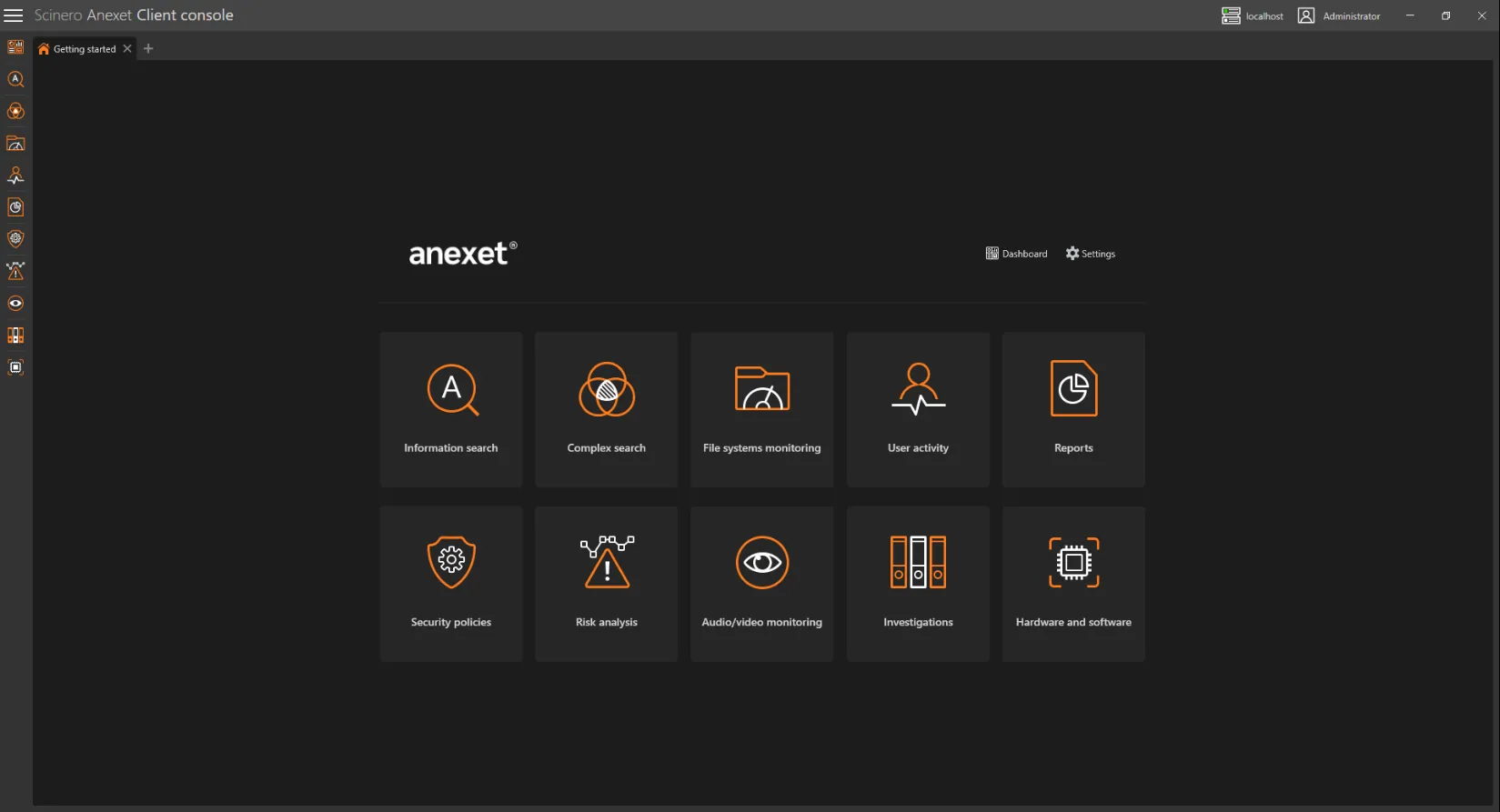
DLP systems are integral part of SOC because their use can minimise the risks of data breaches and protect sensitive company information.
Key SOC Challenges and Problems
With the rapidly increasing digitalisation and the increasing number of cyber-attacks, security monitoring centres are becoming an integral part of cyber defences for organisations. They are responsible for monitoring, detecting, analysing and responding to information security incidents. However, despite their importance and effectiveness, SOCs face a number of serious challenges that can impair their performance and make it difficult to detect threats in timely manner.
Technology advances, cloud services, the Internet of Things (IoT) and sophisticated multi-vector attacks are making traditional approaches to cybersecurity insufficient. Companies are forced to adapt their SOCs by implementing new tools and strategies to counter threats. In this context, there are several key challenges facing modern SOCs.
The main challenges of the Security Operations Center consist of the following issues.
Big data volume and complexity of event processing
Modern SOCs work with huge data streams coming from multiple sources: SIEM systems, network and server logs, anti-virus software, intrusion detection systems (IDS/IPS) and others. The number of security events can reach millions per day, making them difficult to process and filter. Without effective event correlation and incident prioritisation mechanisms, SOC analysts run the risk of being overwhelmed and missing truly critical threats.
Lack of qualified specialists
Cybersecurity is facing a significant talent shortage, especially among experienced SOC analysts with the necessary knowledge and skills to identify complex attacks. The high workload on existing SOC teams increases the risk of human error, increases incident response times, and increases the complexity of the threat investigation and remediation process.
Modern cyber threats and the difficulty of detecting them
Cybercriminals are constantly evolving their attack tactics using social engineering, malware, supply chain attacks, zero-day vulnerability exploitation and other sophisticated techniques. Traditional signature-based detection methods are no longer able to detect new threats, requiring SOCs to implement advanced technologies such as behavioural analysis, data correlation and proactive threat hunting.
Automation and machine learning in SOC
In a highly stressed SOC terms, it is critical to automate incident detection and response processes. Artificial intelligence (AI) and machine learning (ML) can analyse vast amounts of data, detect anomalies in user and system behaviour, and predict potential threats. However, their implementation requires significant investment, proper tuning of models and constant monitoring of their effectiveness.
SOC integration with business processes
It is important that cybersecurity does not exist in isolation, but is closely linked to the organisation's overall business objectives. Failure to synchronise SOC with key company processes can lead to misallocation of resources, underestimation of risks and delays in decision-making.
Compliance with regulatory requirements
Companies must comply with various standards and regulations (GDPR, ISO 27001, NIST, PCI DSS, etc.), which places additional responsibilities on the SOC. In addition to detecting and remediating threats, reporting, auditing, and demonstrating compliance with regulators is a time-consuming and costly endeavour.
Trends and feature
Let's take a look at what the most pressing areas of SOC development will be in the coming years.
Use of artificial intelligence and machine learning
Today, the development of tools that use artificial intelligence to automate processes is particularly relevant. This technology can also be applied in the organisation of the enterprise's security loop as part of SOC work in various areas, from collecting incident statistics and threat analysis to event correlation, detecting anomalies in user behaviour and automatically preventing attacks.
Automating response processes
Today, the trend towards maximum automation of processes in all spheres is relevant. This theme is relevant because it allows reducing financial and labour costs of maintaining a particular process, as well as minimising the impact of human factor. Automation of response processes in SOC allows to significantly reduce the time to investigate security incidents, as well as increase the efficiency and speed of response to identified threats. At the same time, burden on cybersecurity professionals, whose functions are limited to adjusting automated processes rather than requiring them to track the full security cycle of an enterprise, is significantly reduced.
Cloud SOCs
The scalability and flexibility of cloud-based security solutions has been appreciated by cybersecurity professionals and is firmly embedded within SOC. Cloud-based platforms centralise event monitoring across the enterprise, simplify digital asset management and accelerate the deployment of new security tools, including DLP systems.
Development of Threat Hunting
Threat Hunting is the proactive search for threats and prevention of attacks on the enterprise. SOC analysts adhere to the core principles of Threat Hunting: proactivity, Information Security hypothesis analysis, data analysis, event correlation, automation and ML. Threat Hunting is used to identify early stages of attacks, mitigate damage, detect new threats, improve the overall cyber hygiene of the organisation, and increase SOC analysts' awareness of real attacks.
In SOCs, Threat Hunting often complements traditional monitoring and response methods by preventing cyberattacks at the earliest stages.
The rise of IoT attacks and the increasing importance of securing these types of devices
In recent years, there has been a sharp increase in cyberattacks on IoT objects. This is due to the growing number of connected IoT devices, including industrial sensors, controllers and medical devices, expanding vulnerabilities in SCADA systems and programmable logic controllers, the lack of basic cyber protection on many devices and the use of old communication protocols without built-in protection.
To protect critical infrastructure, companies are beginning to adapt SOCs to work with IoT devices. This involves monitoring IoT-specific threats, implementing specialised SIEM platforms for industrial systems, conducting behavioural analysis of IoT devices and network segmentation, and integrating ICS/SCADA systems into the overall cybersecurity landscape.
Quantum technologies and their impact on security
The enterprise must consider the risks of quantum computing attacks, prepare for these threats, and develop post-quantum cryptography algorithms.
Conclusion
SOC plays important role in protecting organisations from cyber threats. Its evolution is moving towards automation, use of AI and integration with various security tools including DLP. Companies that invest in building and enhancing SOCs reap significant benefits in securing data and infrastructure.