


Categories
Profiling
 23
23 8 min
8 min
Psychology is embedded in corporate life quite tightly. There are tasks that can only be solved with the help of psychology tools. And even special methods of determining personality are used – profiling, when a psychological portrait of the environment is analysed. What is profiling? How is it applied? Let's discuss it in the Anexet article.
Definition of profiling
What have you heard about profiling? Profiling is a set of techniques and methods for assessing verbal and non-verbal communication that are used to analyse and predict people's behaviour in a situation or context. Profiling is also known as reading a person, determining their psychological profile; assessing how your brain perceives the person you are talking to.
What is profiling used for?
Profiling is used to assess the personality, its personal qualities and options for using this knowledge in communication. Profiling solves three main tasks: identification of key accentuations of the interlocutor's character taking into account the peculiarities of each person, designing behavioural options in a particular situation, assistance in targeting the person under study in order to increase loyalty in the context of interest.
Initially, such a detailed study of a person's profile, personality reading was used in forensics, the study of the behaviour of criminals. However, profiling is now used in a wider range of spheres of activity:
- in criminalistics (explores the profile of the criminal's personality based on the information available at a crime scene in order to identify true ulterior motives, details of the offence, potential accomplices and the ultimate search for the offender(s) themselves);
- in logistics (search for potentially dangerous passengers on any type of transport service in order to predict critical situations and threats to the safety of passenger traffic and infrastructure);
- in banking and insurance (to predict potential losses caused by insolvent customers or fraudsters);
- in business (to minimise business risks in business negotiations and transactions, analysis of partners for seriousness, honesty and reliability of information and intentions);
- in human resource management and personnel policy (provides screening of undesirable elements before they get inside the protected system (due to lack of competence, motivation, hidden bad habits and addictions, material problems, personal problems interfering with the fulfilment of professional duties, identification of insiders, etc.);
- in the family (to coordinate relationships within the family and identify the source of problems).
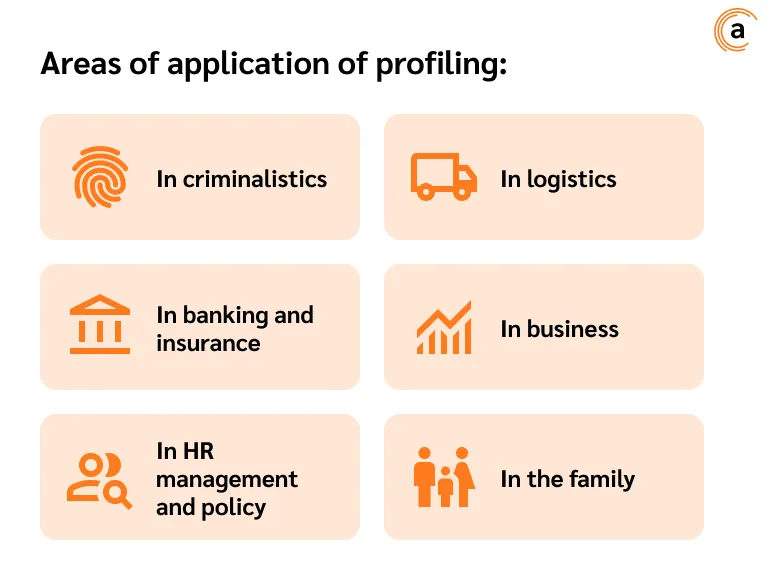
The application of profiling is not limited to these spheres. Every time there is a need for a personal approach or forecasting of social and anthropological risks this methodology can be applied: in the hotel business, marketing, targeted advertising, sales, medicine, HR-surfing and so on.
How do you use profiling?
A specialist who analyses personality by profile type uses all available means of reading. The approach should be as comprehensive as possible, using verbal, non-verbal and contextual communication analytics. The process is also influenced by who is conducting the research. The profiler must be experienced enough to carefully and impartially read the manifestations in communication and draw up an accurate psychological profile.
Verbal communication means
This includes speech (written and spoken), what we literally say when we speak. It is a very important part of our lives and an inexhaustible source of information for analytics. After all, according to statistics, every day we say from 5000 to 30000 words. At the same time, women and men speak differently. Women more – about 20,000 words and men less – about 7,000 words. It's a communication source in its purest form, accessible and open. It's also quite fast. The reading of information can take place at the moment of conversation, as well as in sequential analyses (after listening to audio content, reading a letter, etc.).
When analysing with the help of verbal means, it is possible to give a direct assessment of the interlocutor's motivation, accuracy of the information provided, the level of novelty of knowledge, emotionality and sensuality of speech, life experience, education, the way of formulating thoughts and logicality of conversation, to note ethnic characteristics, culture of communication and so on. This is a rather extensive amount of data.
Non-verbal communication means
This is a way of interpersonal interaction without the use of speech. This includes gestures, facial expressions, postures, intonations, movements during communication, biological reactions of the body (blush during conversation) and others. In short, it is body language that clarifies and complements speech information.
Non-verbal ways of communication make dialogue more understandable, effective, and influence the persuasiveness and effectiveness of information presentation.
Non-verbal means of communication are no less important than verbal ones. A person perceives about 70% of information through these channels, through them the first opinion about him/her is formed. After all, as a rule, before the conversation starts, we already have time to assess a person "on automatic" and make up a portrait of him before the dialogue begins. Non-verbal means of communication are also more truthful, through them true intentions and feelings are more accurately determined than through speech.
Contextual means of communication
It is the mapping of verbal and non-verbal signs to individual characteristics, the personification of actions and the intentions of those actions.
Components of profiling
Metaprogrammes
A basic profiling tool is the identification of a person's metaprogramme. Metaprograms are a set of personal reactions and behavioural patterns that apply to the entire spectrum of a particular person's experience and life cycle. In simple terms, we can say that it is a map of behaviour in the brain in which there is a linear ranking of actions (conventionally, there are "Yes" or "No" responses to each step). Another analogue: basic software, a Windows package in everyone's head.
By determining the type of metaprogram, the profiler will be able to understand how the subject under investigation models thinking. Metaprograms are not based on an expert's subjective judgement. It is an evidentiary toolkit, an axiom, not a theorem in personality assessment.
With the help of metaprograms it is possible to determine the general characteristics of a person, his way of life, patterns of behaviour, beliefs and general picture of the world, possible stereotypes he is guided by, personal qualities, to carry out professional adjustment of activity, to adjust the impact in accordance with the type of programme and so on.
Emotional profiling
This is the identification of the leading emotional reactions that are inherent in each particular person. Defining the emotional base helps to determine each person's thinking style and perceptual prism, in which external signs this emotion will be expressed.
Pyramid of values and goals of the individual
People consciously follow a path of realising their goals and supporting values. Identifying this type of personality characteristic will help you understand how similar your and your partner's behavioural approaches will be. At the same time, a person is not an "open book", they tend to hide their true intentions, or they may not fully realise their goals at all. Profiling based on a pyramid of values and goals helps to ensure the right level and angle of influence on a person.
A man's character and his masks
Profiling technologies with a high level of accuracy help to determine the character of each person, as well as a set of social roles and masks to play them, behind which they hide. This helps to separate the external visual elements of self-presentation from the real reference points on which a person relies.
Linguistic and presuppositional analysis of speech
Provides for the assessment of the individual on his or her personal speech patterns, sentence formulation, written and oral literacy, use of word forms and syntactic constructions.
Each of the profiling areas studies a part of the personal portrait of the person under study, which in the end adds up to a complete picture that helps to determine risk factors when interacting with him/her, the degree of loyalty and competence in matters of interest, to adjust professional and career potential, to identify weaknesses and pains, as well as to provide a targeted impact on the person if necessary.
Personality profile: archetypes
The general approach in profiling boils down to the fact that, based on all the above-mentioned tools, one should correctly define a psychological profile of a person and take into account his or her personal characteristics. Experts continue to debate how many such profiles exist, and as a rule, many people interpret the definitions of these profiles themselves. There are known divisions according to Jungian, Freudian, post-Jungian, post-Freudian, and author's type of archetype distribution. Let's consider one of the popular models of the last decades Litchko-Leongard, according to which there are 12 psychological profiles of personality:
- pedantic (accurate, neat, non-conflicted, inert);
- stuck (shrewd, vindictive, goal-orientated, with a clear boundary for their social circle of own/not their own);
- agitated (poorly controlled, impatient, emotional, easily excitable);
- hyperthymic (sociable, always in resource, impulsive, hyperactive, easily excitable);
- extraverted (directed to outside perception, self-centred, easily influenced);
- dysthymic (weak-willed, pessimistic, with low self-esteem, inhibited);
- affective-labile (cyclical, sensitive, attention-seeking);
- exalted (enthusiastic, active, with elements of excessive drama);
- anxious (overly sensitive, socially withdrawn, nervous);
- emotive (feeling the full range of emotions, empathic, receptive to the environment);
- demonstrative (agile mind, artistic, easy to lie to, adventurous);
- introverted (focused on their own perception, deeply analyses their own emotions, imaginative, detached from others).
Why use psychotypes in profiling? Psychotypes are used as an initial matrix to determine the relationship of the interviewee to one of these groups. After obtaining this general information, the profiler examines the personal characteristics of character and behaviour. Sometimes this general profiling is also used for general personality typology.
Can profiling help you identify lies?
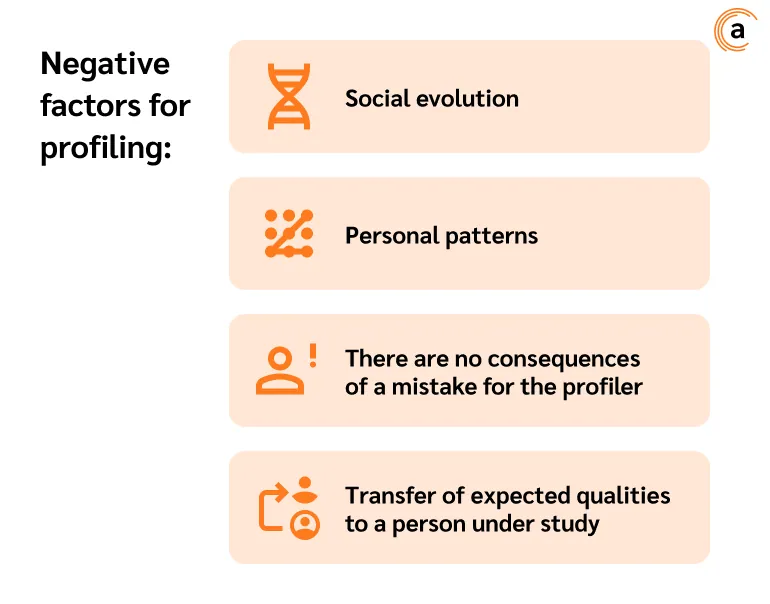
Profiling is determining how the brain understands another person, finding his or her psychological portrait, answering the question: what is broadcasting outwardly is true and what is false, feigned, invented within the framework of one's social role. That is, yes, the tools will help to determine whether a person is deceiving you at the moment or not. However, it is not 100% accurate. The following factors negatively affect the result:
-
social evolution. Humanity was not originally formed in such a way that the reaction to this or that stimulus was 100% clear. There is a constant evolution, including in the world of emotions and their defence. Of course, there is a margin of error for personal qualities, someone can more coping with their own reactions, someone less. As a rule of thumb, the average accuracy of a profiler is 70%;
-
personal patterns. The imprint of the profiler's very personality can also give a negative effect during the analysis. In this case, the expert transfers his experience to the person under investigation and draws conclusions with a margin of error;
-
there are no consequences of a mistake for the profiler. This is a peculiarity of the psychological structure of each person: if we do not see the consequences of our mistake or the potential threat of punishment, we do not give 100%, we look for a lighter alternative. Possible punishment induces to more efficient and active action;
-
transfer of expected qualities to a person under study. This is called the halo effect – when a interlocutor involuntarily assigns a certain set of qualities to the other interlocutor, based only on his/her appearance. For example, we attribute to a person in a business suit the qualities of a businessman: business acumen, ability to analyse, seriousness, etc.
In profiling, there is a set of special tools that are aimed specifically at finding deception, lies and true motives of a person. They are also called keys or rules for finding deception:
-
constant (defining a norm of human behaviour from which to base an assessment);
-
change (observing and recording any deviation from the norm accepted in the constant);
-
clusters (identifying verbal and non-verbal actions that correspond to emotions and lies);
-
consistency (comparing reactions to specific questions and matching them to clusters that correspond to truth and lies);
-
prejudice (one should not approach the identification of lies and truths with personification, transference of personal qualities, prejudice);
-
contamination (neutrality towards the interlocutor, no need to become a stimulus in the conversation, which will affect the purity of the evaluation);
-
cross-validation (additional exploration of reactions to the opposite of the topics of interest).
In practice, the application of these rules and their effectiveness depend on the experience and professionalism of the profiler, on the internal data of the person being researched, and in some way on the circumstances of the external environment that affects the moment of the research. It is very difficult to determine a lie. And the whole process is influenced by indirect and direct factors.
Where is lie detection using profiling used? In forensics, business analysis, in the work of political consultants, sales, marketing, in profiling new employees and evaluating old ones, and many other areas. In general, any field that involves communicating with different numbers of people, selecting an individual approach to a person, using a psychological portrait for a smoother entry into the team, can use profiling tools. Profiling provides significant assistance in assessing the business and personal qualities of partners, their reliability and loyalty, true motives and plans.
Digital profiling
In modern professional profiling there is a new definition – digital profiling. It is the study of a person's personal data and profiling based on online activity, as well as conducting specialised testing and questionnaires that will help to determine the type of psychological profile of a person even without physical contact.
Digital profiling is very popular today, especially in the field of HR management. Employees of HR departments and agencies use this type of analysis to correlate the real profile of a candidate with the needs of a particular vacancy. This helps in finding the best candidate who is suitable for the given job and set of responsibilities. From a company's perspective, digital profiling helps in:
-
effective personnel management, selection of employees suitable for the position;
-
creating an environment for the development of employees and their potential, helping to ensure a targeted approach to training and the use of labour resources;
-
increasing the length of an employee's employment with the company by selecting a job profile that is more suitable for the individual.
The use of digital profiling has become even more efficient with the implementation of artificial intelligence tools. Big Data and machine learning provide access to a large amount of data in research, which means profiling happens with greater accuracy and in real time.
Conclusions
Profiling is a methodical and evidence-based process of investigating a person, their characteristics and finding their true motives. It is a voluminous complex work, which is carried out by professionals. Personification of processes and objects is a new trend of the XXI century, when even common at first glance actions are directed to a specific target audience, taking into account its characteristics, positive and negative sides. The use of profiling ensures not only the reduction of medium- and long-term costs, but also psychological comfort in the team, as well as the effective implementation of business plans.