


Categories
Information Security of telecommunication systems
 23
23 14 min
In this article we will consider the main threats to Information System security of telecommunication systems, as well as methods of data protection in them.
What is the telecommunications system?
The telecommunication system (hereinafter — TS) is a network of communication channels designed to exchange information between users through various means, such as IP-telephony, e-mail, television and others.
Thanks to telecommunications you can catch the news on TV and radio, make phone calls, send text and voice messages, emails, and use internet resources and social media platforms. Telecommunications have made it more efficient, cost-effective and convenient to transfer information between users or subscribers.
Today, telecommunication networks are actively used in all spheres of human activity: business, banking, industry, healthcare, energy, media, etc.
Among others, the following telecommunication networks are distinguished:
-
computers — needed to transmit digital data;
-
telephones — used to transmit voice information;
-
radio — used to transmit sound information;
-
TV — needed to transmit sound and image.
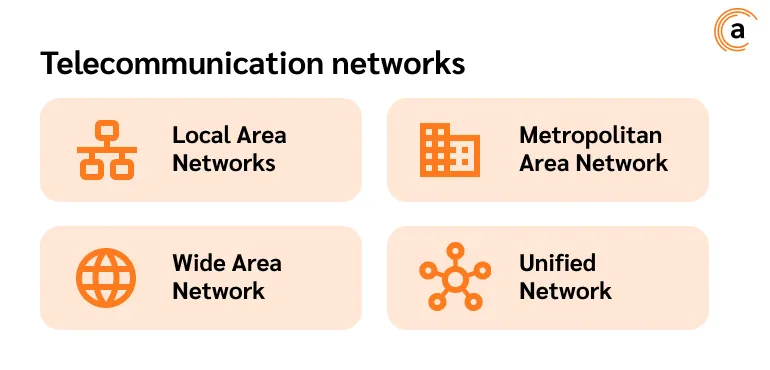
Both small companies and large organisations around the world rely on services offered by telecommunications companies. Enterprises may use services such as Internet, fixed and mobile telephony, and other types of communication technologies depending on the capabilities and business objectives being realised. Corporate computer networks are the most versatile and useful for businesses.
There are four types of corporate computer networks:
-
Local Area Networks (LANs). Used to provide communication in relatively small information infrastructures: offices, clusters of buildings, factories.
-
Wide Area Network (WAN). Used for networks that cover large areas, such as those serving major cities. Many international companies use WANs to enable communication between staff, suppliers, customers and employees of other organisations in other cities, regions, countries and the world.
-
Metropolitan Area Network (MAN). Typically combines many local area networks (LANs) into one large network.
-
Unified Network (Internetwork). Connects two or more networks using a variety of equipment, including routers, bridges, and gateways.
The type of computer corporate network is chosen based on the size and requirements of the organisation.
Security issues of telecommunication systems
More often telecoms networks are large and complex infrastructures because they have developed organically over a long period of time.
At the same time, these vast networks continue to grow in complexity as technology advances, for example, with the growing popularity of Internet of Things (IoT) devices and the deployment of 5G infrastructure. As networks grow and become more complex, so does the attack surface for malicious attackers.
In addition, telecommunications networks are also burdened by the vast amount of personal and sensitive data transmitted over them. Data protection, which includes personal and financial information, is of course not only a financial and reputational issue, but also a legal one.
The telecommunications industry is uniquely positioned at the intersection of recent technological breakthroughs, geopolitical tensions, economic shift and societal development. As a result, it is exposed to a large number of threats that are arguably more complex and volatile than in any other area of activity.
Types of threats to telecommunication systems
Threats to telecommunication systems may lead to a breach of the integrity, availability and confidentiality of transmitted information. There are physical and information threats to telecommunication systems.
Physical threats
Improper operating conditions. This is a violation of rules and guidelines for the use of hardware, software, and other network components. This can lead to performance degradation, malfunctions, equipment damage and other problems. Improper operation of telecommunication systems may include: failure to maintain temperature and humidity conditions, use of incompatible or low-quality equipment, improper connection and configuration of equipment, lack of regular maintenance, and others.
- Depreciation of equipment. Depreciation may be manifested by reduced system performance, increased response time, data loss, outages, and other problems.
- Natural disasters. Earthquakes, hurricanes, fires and floods can damage infrastructure, including cell towers, fibre optic cables and other network components. This may disrupt the availability of information in the affected areas.
- Human factor. This refers to unintentional human action or inaction that leads to failures in the operation of telecommunication systems. Errors can occur at any stage of system operation: during design, installation, configuration, use and maintenance of equipment.
- Sabotage. This is the deliberate damage or destruction of telecommunications infrastructure in order to disrupt its operation. This can be done for a variety of reasons, such as political motives, to gain a competitive advantage, or for personal reasons.
- Physical threats from natural disasters, infrastructure failures and malicious human actions are usually impossible to predict, but it is possible to reduce the risks of their occurrence and minimise the damage they cause — with proper preparation.
Information threats
Cyber threats targeting telecommunications networks are nothing new. Telecommunications is an essential tool in everyday human activity. It is a kind of «bridge» that connects and ensures the interaction of organisations, enterprises and even entire industries. In the current geopolitical situation, disruption of information communication within a country is a target for cybercriminal groups.
In addition, information transmitted via TC may be particularly valuable to cybercriminals. Cybercriminals can exploit vulnerabilities to steal personal and corporate data, as well as other sensitive information. Data leaks not only cause financial losses, but also damage the reputation of an enterprise.
The following types of information threats to TC are distinguished.
Internal threats. These are intentional or unintentional acts or omissions by employees that may cause system malfunctions or compromise the integrity, confidentiality or availability of transmitted information.
Important! Although some attacks on the system are malicious, many loyal employees are not aware that their actions pose a threat to the organisation's information security. To reduce the risk of exfiltration or destruction of protected information through the fault of personnel, it is advisable to implement the system of cybersecurity training.
DDoS attacks. Distributed Denial of Service (DDoS) attacks are widespread in the telecoms sector. These attacks overwhelm networks with a flood of Internet traffic, rendering them unworkable and denying legitimate users access to information resources.
Man-in-the-Middle (MitM) attacks. Attackers intercept and modify communications between two parties without their knowledge. In telecommunications, this may jeopardise integrity of information transmitted over networks, including voice communications.
Ransomware programmes. This type of malicious software blocks legitimate users from accessing their systems or personal files and demands a ransom to restore access. Telecommunications networks are particularly vulnerable to ransomware programmes attacks because of their critical importance and wide availability.
5G infrastructure exploits. As telecom companies deploy 5G networks, they have to contend with new vulnerabilities associated with the technology. These include risks arising from the increased use of software to manage network operations and the integration of IoT devices into the network.
Internet of Things (IoT). One of the biggest problems for telecoms at the current level of technology is the Internet of Things. The IoT has created more entry points for attackers' actions. Not all of these points are properly patched, and they leave user, customer and company accounts vulnerable.
Terrorists and foreign state structures may also pose a threat to telecommunications systems. They can use various methods, such as cyber attacks, sabotage or other forms of interference, to disrupt systems or obtain valuable information about intellectual property, trade agreements and personal data.
Some of these attacks are aimless and come from low-level criminals, but in many cases telecommunications networks are often targeted by highly organised cybercriminal groups.
Tasks of a telecommunication systems Information Security specialist
Ensuring information security of telecommunication systems is one of the key tasks, the solution of which is entrusted to a specialised unit — the information security service. Information Security specialists must have deep knowledge of the legislation regulating information protection issues, as well as skills in timely and effective implementation of software, hardware and technical means and control over the actions of the company's employees.
The tasks of a telecoms Information Security specialist include:
-
predicting and modelling Information Security threats;
-
risk assessment;
-
checking the operability and efficiency of the software and hardware tools used;
-
analysing system performance and sustainability;
-
restore system operation in case of failures;
-
development of safety policies, rules, regulations, instructions, etc.
Methods of information protection in telecommunication systems
Unfortunately, it is impossible to completely eliminate unauthorised access to telecommunications system components and their modification or destruction. Nevertheless, measures can be taken to help reduce the risks of confidential information leakage.
The following information security methods help to secure telecommunication systems and prevent the leakage of confidential information.
Technical methods
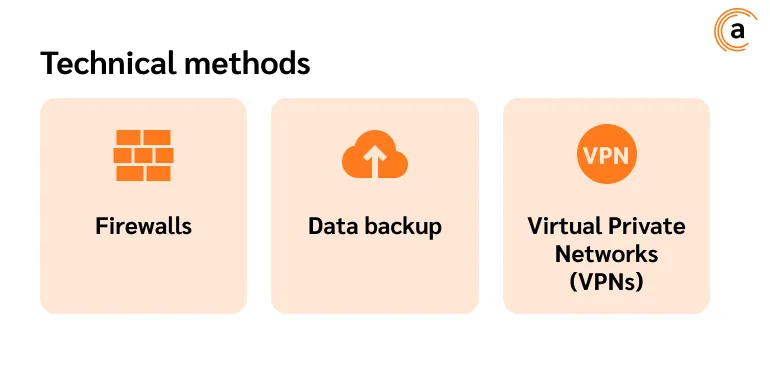
This refers to the use of the following technical means and methods to protect information.
-
Firewalls. Necessary for controlling network traffic and filtering data passing through the network. Typically, filtering routers, session gateways, proxy servers, and personal firewalls are used for security.
-
Data backup is necessary to restore system operation after failures or crashes. There are full backups, incremental backups (or additional backups), i.e. backing up only the data that has been added or changed since the last full or incremental backup, and differential backups, i.e. backing up only the data that has been changed since the full backup.
-
Virtual Private Networks (VPNs) — provide secure remote connections for telecommuting and travelling employees.
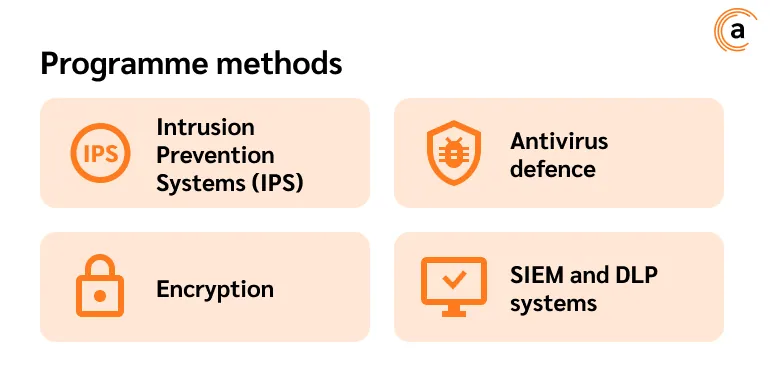
Realisation of the safety functions using the following software.
-
Intrusion Prevention Systems (IPS). Designed to detect and block network attacks in real time. IPS monitor traffic patterns to identify malicious activity, security breaches, vulnerabilities, or threats that firewalls may miss.
-
Antivirus defence. To protect telecommunication systems, you can use various antiviruses that offer comprehensive data security solutions.
-
Encryption secures sensitive information from unauthorised access or attempts to modify it. It encrypts data using special algorithms and keys, ensuring that only parties with decryption keys can read it.
-
SIEM and DLP systems. Continuously monitor user and software activity, capture data and analyse network activity logs to quickly detect potential attacks and anomalous behaviour indicative of breaches.
Organisational methods
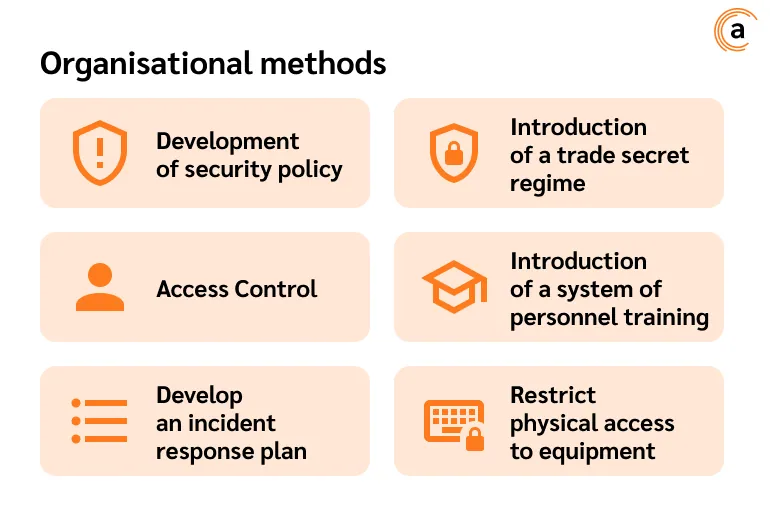
Measures aimed at ensuring the security of information by regulating the activities of personnel and the use of system resources.
- Development of security policy: development and implementation of security rules, identification of information assets to be protected, defining the area of personnel responsibility for violations.
- Introduction of a trade secret regime.
- Access Control. Regulates access to networks and systems by implementing strong authentication, authorisation and accounting. Techniques such as multi-factor authentication and role-based access restrict third parties from accessing protected resources.
- Monitor user activity and compliance with Information Security rules. Can be performed using the Anexet DLP system.
- Introduction of a system of personnel training in the basics of Information Security.
- Develop an incident response plan. No single information security method can't reduce information security risks to zero, so it is advisable to develop an incident response plan, i.e. write manuals detailing the roles, responsibilities and actions required to effectively contain breaches.
When organising an Information Security system for telecommunications systems, it is important to ensure physical security of telecommunications infrastructure as they are open to attack, vandalism and theft. Protecting the communications infrastructure includes the following activities.
-
Restrict physical access to equipment. This can be achieved by installing fencing, access control systems (ACS), video surveillance, alarm systems and other technical means.
-
Ensuring reliability and safety of buildings and structures. Buildings housing telecommunication systems must comply with fire safety, earthquake resistance and other regulations.
-
Protection against natural disasters. Telecommunication systems should be protected against natural hazards such as earthquakes, floods, hurricanes and fires. This requires: regular inspections of equipment condition, development of emergency response measures, and installation of fire alarms.
Are DLP systems suitable for protecting telecom companies' data?
DLP systems may be useful for securing telecoms systems for the following reasons:
-
Protect against insider threats. Help prevent data leaks caused by the organisation's personnel. This is especially important for telecommunication systems that transmit large amounts of personal and sensitive data.
-
Enable compliance with legislation, including meeting the requirements of the Federal Law «On Personal Data».
-
Continuously monitor employee activity at workstations. DLP systems continuously capture and analyse data transmitted through all communication channels used in organisations. This allows companies to proactively identify unreliable and potentially dangerous employees and prevent fraud and sabotage by staff.
In conclusion
None of the methods discussed individually cannot completely remove all information security risks. Only by using them in combination can we significantly minimise risks of loss of availability, destruction, alteration and leakage of data from telecommunications systems.
For effective information security requires it is necessary to involve the top management of the company, development and implementation of strict security policies, risk assessment, employee training, vulnerability testing, Information System audits, use of specialised software, etc.