


Categories
Information Security of Databases
 23
23 15 min
Databases are the aggregate of a large pool of information organised in one or more subjects. This technology is basis for preservation of information in all areas of human activity. Therefore, Information Security of Databases is extremely important for companies. Let's explore this topic together with Anexet.
Database definition
Database (DB) is the system of organised storage of information for further processing and management of this data. The main principle of creating databases is to provide quick and easy access to stored information. Modern Databases are used in almost all areas of life — in banking and financial organisations, educational institutions, public services and other organisations.
The importance of organising protection grows along with increase in the amount of data stored in Databases, the level of their confidentiality and growing number of threats aimed at their compromise.
What types of Databases are there?
Databases are used in various fields, and there is a certain classification of their types depending on the method of organising information.
Relational Databases (SQL) are the most popular type of Database. Information in them is stored in the form of tables (relational model), where data is structured and linked to each other. The main advantage of this type is its intuitive organisation and ease of use. Each row in the table represents a record identified by a unique key, and the columns contain necessary attributes. This makes it easy to build relationships between data.
Non-relational Databases (NoSQL) are another way of organising data, providing the high scalability and flexibility of structure. Unlike traditional relational systems, non-relational Databases are not limited to tables and provide more opportunities to work with large amounts of data. These Databases are ideal for working with Big Data.
Object-oriented Databases (OOBDs) store information in the form of objects, which makes them particularly useful for use in programming.
Graph databases build structure of information on basis of nodes and their interconnections (edges), which allows you to effectively analyse and display complex relationships between objects. This approach is convenient for processing data with multiple relationships between stored information.
Why is Database security important?
Databases store critical and sensitive company information (such as financial, personal, banking, business data, etc.). This is not just array of data, but a real complex of all information assets that a company possesses and that directly affect its efficiency, competitiveness and survival. Breach of Database security can result in financial losses and reputational damage for the company.
Modern cyber threats are largely focused on this value and exploit opportunities to penetrate the enterprise's security perimeter.
Database tasks and their dependence on Information Security
What tasks do Databases perform? Several main tasks can be identified:
-
ensuring confidentiality. Databases protect information that is important to an enterprise from negative influence by hostile individuals;
-
ensuring information integrity. Databases, as a unique means of storing information, ensure simultaneous integrity of data and their interrelationships, as well as structured preservation of narratives;
-
ensuring timely access to stored data array. Databases are open to authorised users at any time, unless otherwise specified in terms of use;
-
ensuring user identity verification through authentication and authorisation;
-
ensuring event logging and auditing of user activity in the system to identify and prevent potential threats.
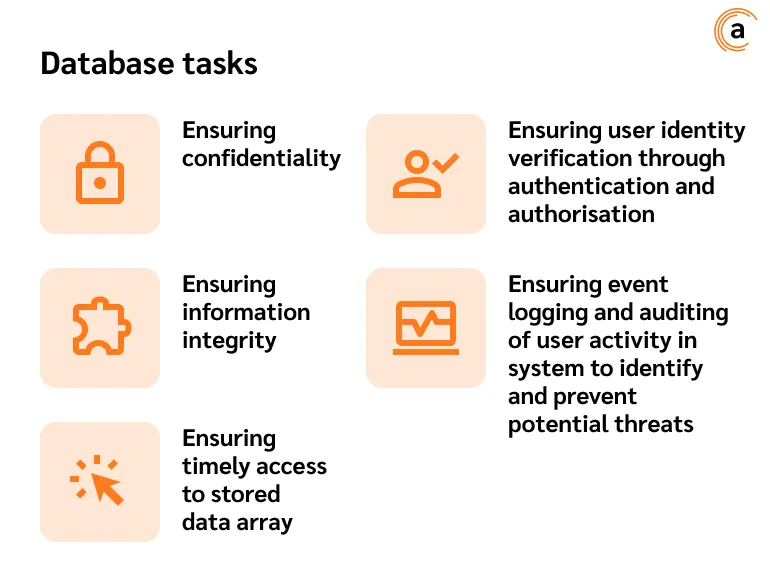
Accuracy and reliability of these tasks directly depends on Database security, which is why it is so important to create optimal conditions for using this type of information storage.
Database security threats
Since Databases have a wide range of applications, the main threats to their security are also varied and cover many types of standard Information Security issues. Let's take a closer look.
-
Distributed Denial of Service attacks (DDoS)
These are massive attempts to gain access and authorisation for users in the system, aimed at forcing Database servers to overload and denying service to all clients without exception, including authorised ones.
-
SQL injections
This is a method of hacking websites or programmes based on Databases. Fraudsters insert malicious SQL code that executes pre-determined commands such as tracking traffic or intercepting confidential data.
-
Unauthorised access
One of the main threats that can originate from both internal security circuits and external objects. An attacker gains access to confidential data stored in the database by capturing authorisation and can perform any type of action on this information.
-
Internal threats due to carelessness
Employees or other internal users may accidentally or intentionally damage information in Database. This type of intrusion requires constant monitoring, as there is no need to authorise users or seek intrusion into the enterprise security perimeter.
-
Malware and viruses
The negative impact of malware and viruses can have significant consequences for a business: encryption, modification, blocking of access, deletion or distribution of data stored in Database.
General principles of Database security management
Based on existing security risks, the main principles that should be applied to Database security management are minimising access rights to information, encrypting data, monitoring web activity, regularly updating software and creating backups.
Minimising access rights provides the first level of Database security by limiting the circle of trusted individuals and distributing their roles within Database. Several separate roles can be identified:
-
DBMS administrator;
-
Database administrator;
-
security administrator;
-
user.
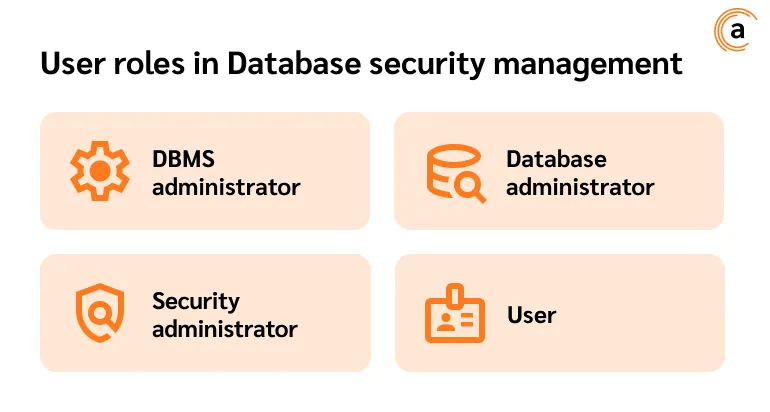
A DBMS administrator is a specialist who manages software designed to create, modify and manage database queries. Their main responsibilities include installing and configuring DBMS, monitoring the system, optimising queries, backing up and restoring data, and other functions. They have necessary rights to perform these tasks.
Вatabase administrator may have a wide range of tasks related to managing the data itself, its structure and use. They are responsible for designing the Database, ensuring its integrity, managing tables, indexing and keys to improve performance. Their responsibilities also include supporting queries and reporting.
The cybersecurity administrator is also responsible for databases as part of the company's overall security. They can implement additional levels of protection, such as two-factor authentication for administrators and users, and monitor activity in the system.
A user is a regular company employee who has access to Database only within the scope of their job responsibilities.
Each role associated with Database management has its own characteristics and restrictions in terms of the access level and privilege usage.
Data encryption in Databases: role
Data encryption is a critical method for protecting Databases from unauthorised access and cyberattacks. It involves converting data into an encrypted form using algorithms such as symmetric AES, asymmetric RSA and SHA hashing. Only those who have the appropriate key can decrypt data and access it. Encryption is used both for storage (on servers and external media) and for transferring information between a client and server or between servers. At the application level, encryption can also occur before data is written to Database.
Encryption also includes cryptographic key management (e.g., using services such as HashiCorp Vault, AWS KMS, or Azure Key Vault), which provide secure storage and access management. In Databases, encryption technology is often integrated at the DBMS level and works automatically, encrypting and decrypting data with minimal impact on system performance. This is especially important for protecting data at rest, as it does not require significant changes to storage architecture.
Encrypting backups is a mandatory security measure. If backups fall into wrong hands, attackers can gain access to data. Therefore, administrators usually encrypt backups for protection.
Monitoring user activity
User activity monitoring involves continuously tracking employee actions and Database-related processes to identify suspicious activity. This may include detecting unauthorised access, credential sharing, or Database information leaks.
Provides continuous monitoring of Database activities performed by employees, users and processes in Database to identify abnormal activity, which may manifest itself in unauthorised access, transfer of login and password for authorisation, or dissemination of information from Database.
To monitor user activity, you can use the Anexet DLP system. It provides transparency of employees' digital activities and blocks distribution of confidential data.
Regular software updates
Ensures timely elimination of vulnerabilities by installing updates from a software vendor that address identified security issues. An information security administrator can track updates manually as new versions are released by software vendors, or create a specialised schedule and adhere to it.
Backup
One of the most effective tools for mitigating the consequences of security breaches, especially with regard to Database protection. Backups ensure that data in Database remains intact in the event of an attack.
Database security software and services
There are various specialised programmes and services that help to protect Databases:
-
DBMS Security Features. Provide installation of built-in security features, such as encryption and access control, offered by modern Database management systems (e.g., Oracle, Microsoft SQL Server);
-
Intrusion detection systems (IDS/IPS). They analyse traffic for suspicious activity and prevent potential attacks;
-
Database monitoring (DAM). Special tools that track all actions in Database to identify threats;
-
Database firewall. Protects Databases from unauthorised network attacks;
-
DLP systems for monitoring Database user activity and preventing the dissemination of confidential information from Databases.
Database authentication methods
Authentication is the process of verifying a user's identity before granting access to Database. It is particularly relevant in the context of Databases, as it ensures differentiation and accuracy in granting access in accordance with established roles within an enterprise. The most popular methods for Databases are:
-
use of access passwords. Provides basic protection at the level of initial access to Database when correct user login and password are entered;
-
two-factor authentication. This is achieved by adding an additional authentication step (factor) through confirmation of identity of a user who has already entered the correct login and password. Additional factors may include a password, a message sent to a mobile device, or biometric identification;
-
use of protocols for authenticating users and services through trusted servers. Often used in corporate networks. They act as a kind of router, a secure gateway between the Internet and users;
-
database authentication via tokens. Used to access Database via temporary digital tokens generated by a server. This token is a unique key generated by the system and transmitted to a user to access protected resources. Thus, the user receives the token from the service or application and can authenticate to Database without a login and password. However, the validity period of this token is limited, unlike a password and login.
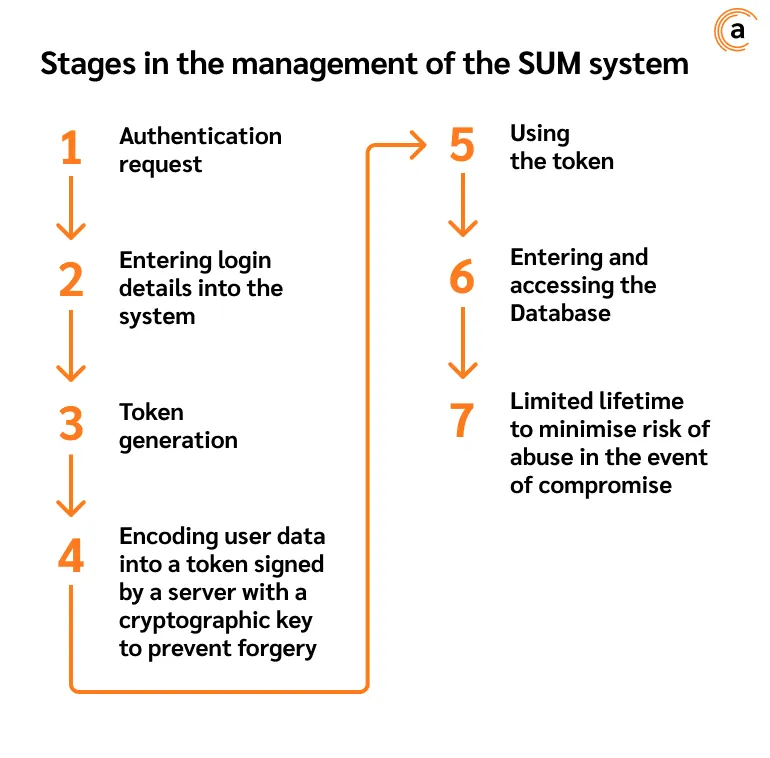
How token-based authentication works:
-
authentication request;
-
entering login details (username and password) into the system;
-
token generation;
-
encoding user data and presenting it in the form of еру token, which is signed by a server using a cryptographic key so that it cannot be forged;
-
using the token;
-
entering and accessing the Database;
-
token lifetime;
-
limited lifetime to minimise risk of abuse in the event of compromise.
Audit methods in Databases
Why is it necessary to conduct Database audits? This process, like security system and business process audits, is vital for ensuring Information Security. It consists of analysing data operations and verifying their authorisation. If discrepancies between access rights and operations are detected, account blocking, monitoring of actions taken and analysis of causes of intrusion may be applied.
The main methods of Database security auditing include:
-
transaction logging. Recording of all operations related to data access, which allows tracking the history of changes and, in the event of a failure, restoring the version to before negative impact;
-
monitoring user actions and analysing abnormal activity. Tracking user activity, including authorisation, data changes and unauthorised attempts to access Database. At this stage, it is logical to use the DLP system;
-
periodic checks of information protection systems in Databases. Regular analysis of security systems, their relevance and accuracy will ensure timely detection and elimination of vulnerabilities.
Conclusion
Database Information Security is a complex process that requires a comprehensive approach. Security threats evolve alongside technology, and companies must implement effective measures to protect their data. From robust authentication and encryption to regular audits, each measure helps maintain a high level of protection and prevent data breaches that could cause serious harm to both users and businesses.