


Categories
Information Security automation
 23
23 12 min
In this article we will look at some tools for Information Security automation in organisations.
What is Information Security automation?
Information Security automation is machine execution of data protection operations aimed at detecting and deterring Information Security (hereinafter referred to as IS) threats.
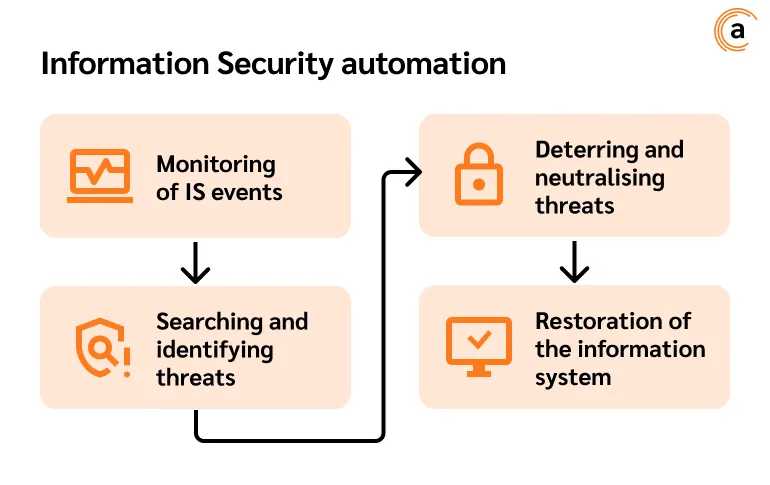
Actions performed by safety automation tools include:
- monitoring of IS events, analysing for anomalies and patterns to identify potential threats;
- threat classification using the same techniques used by specialists in manual analysis;
- decision making on the most appropriate action to control incident;
- organising actions to neutralise the incident and minimise its consequences;
- restoration of initial state of the organisation's information system.
Automation is becoming the only possible tool to improve the efficiency of IS systems in the face of an ever-growing number of threats and chronic shortage of skilled professionals. For example, by the end of 2024, the number of IS vacancies jumped by 17 per cent to over 27,000 jobs.
How does security automation work?
Security automation involves replacing manual routine tasks with automated processes to detect IS incidents, threats and vulnerabilities, and then investigate and respond.
For example, automation tools can scan networks for vulnerabilities, prioritise them based on risk and even apply patches or, if access is not available, recommend remediation steps. Automation eliminates the need for constant manual monitoring and improves the overall efficiency of the Information Security department.
Benefits of security automation
The following advantages of automating routine tasks can be highlighted.
Promptly detect and respond to threats
Automated security systems can process huge amounts of data around the clock and detect violations that are difficult for humans to recognise — especially in a short period of time. Speed of incident detection, localisation and remediation is crucial.
Reducing the impact of human factors
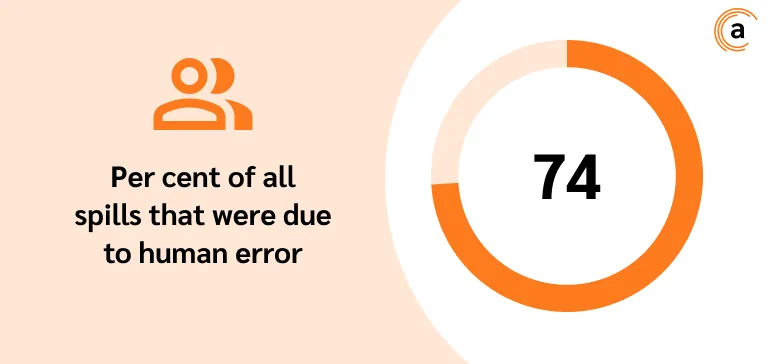
Security analysts are often overwhelmed by sheer volume of incidents requiring attention. This can lead to errors. In fact, more than 74% of breaches involved human error, according to Verizon's 2023 Data Breach Investigations Report.
IS automation eliminates the need to perform many of routine, repetitive tasks typically assigned to security officers, and reduces incident response and remediation time. All of this minimises potential risks to business and its processes.
Budget savings
Security automation provides significant cost savings by reducing the number of manual operations. Reduced operational costs allow resources to be redirected to more strategic tasks, such as refining security policy, assigning roles and responsibilities, assessing the overall effectiveness of the IS system, and more.
Compliance with regulatory requirements
Regulatory requirements in IS field are constantly tightening. Compliance with industry regulations can take time and effort. Automated tools simplify this process by providing continuous monitoring and reporting.
Risk assessment and forecasting
Reducing IS risks is an important task for productive work of any organisation. Automation helps to assess and predict risks, which helps to minimise potential damage from their occurrence.
Automation, using the most common process model of risk management as an example, takes over some processes that would take time and resources to perform manually. This includes inventory of organisation's information assets, verification of implementation of measures, continuous monitoring of security events, collection and analysis of monitoring data, and so on.
Processes — basis of IS automation
At the heart of IS automation is establishment of incident response and information asset (IA) protection processes.
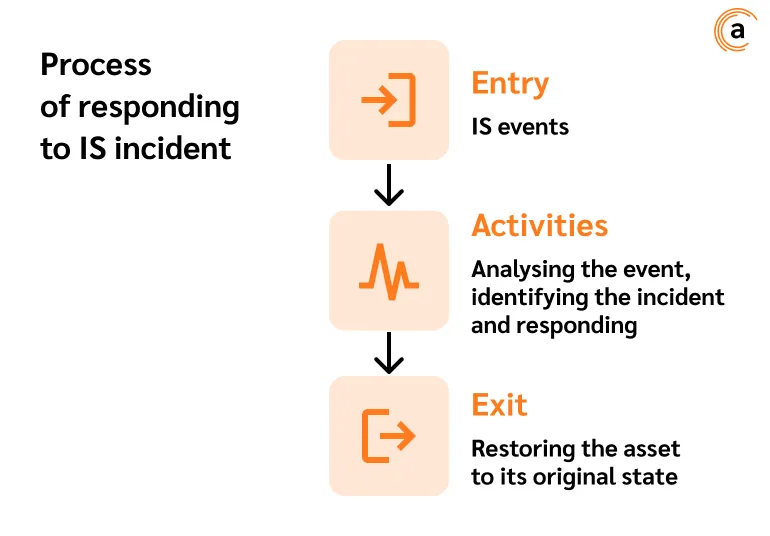
Process of responding to an Information Security incident consists of:
- entry — IS events,
- activities — that is, analysing the event,
- identifying the incident and responding,
- exit — that is, restoring the asset to its original state.
Processes are centrepiece of Information Security and are implemented at different management levels: strategic, functional, operational.
Strategic level of IS-management
It is realised through the IS management system.
Appears in processes of planning, implementation, control and debugging.
Functional level of IS-management
Realised in the provision of Information Security.
It is manifested in IS processes: event monitoring, incident and vulnerability management, implementation of measures to organise physical protection, prevention of confidential data leaks, control of personnel activity, etc.
Operational level of IS-management
Realised through the security subsystem of each specific information asset.
It is manifested in processes of ensuring the IS of specific assets. For example, differentiating access to a certain document, updating software, implementing anti-virus protection, etc.
Examples of safety automation tools
There are a large number of tools available today to ensure an organisation's Information Security — there is a tool for almost every process outlined above.
Next, we'll look at the most common automation tools used at each level of management.
Strategic management level
Security GRC (Security Governance, Risk Management and Compliance). GRC systems automate planning, monitoring, management, control and optimisation processes based on data consolidated from multiple subsystems. GRC solutions can be highly specialised, i.e. aimed at solving specific tasks, such as auditing compliance with requirements of legislation on personal data protection or security of critical information infrastructure facilities. There are also complex solutions with flexible functionality and ability to customise them in accordance with requirements of the particular information system. Significant disadvantage of complex solutions is their high cost and long implementation process. At the same time, such settings of such systems can be adjusted in accordance with changes in the organisation's work.
Implementation of GRC-systems allows to effectively manage the organisation's IS, optimise and accelerate data protection processes, and comply with strict regulatory requirements.
Functional level
SOAR (Security Orchestration, Automation and Response). SOAR platforms gather intelligence about IS events from multiple sources, analyse them for breaches and respond with little or no human involvement. They consist of three main components: security orchestration, security automation, and IS threat response.
SOAR platforms gather intelligence about IS events from multiple sources, analyse them for breaches and respond with little or no human involvement. They consist of three main components: security orchestration, security automation, and IS threat response.
SIEM (Security Information and Event Management). Class of products designed to collect and analyse IS event data. Unlike SOAR platforms, SIEM platforms combine log and event data from multiple sources to help organisations detect, analyse and respond to potential security incidents.
SIEM combines security information management (SIM) and security event management (SEM) into a single tool. SIEM tools use collection agents to gather information from devices, servers, infrastructure, networks and systems, as well as security tools such as firewalls, anti-virus software, data loss prevention tools, secure web gateways and IDS/IPS. Collected information is used by SIEM systems to identify potential anomalies and threats. Systems then alert authorisers of any security events.
IdM (Identity Management). It is structure of policies and technologies aimed to ensure security of the information systems (hereinafter referred to as IS) and data by controlling access of users and devices to internal information and technical resources. IdM allows to automate the processes of identification, authentication and authorisation of users, user groups or software by means of various attributes, including credentials, configured access rights, roles and so on.
If necessary, organisations can resort to centralised authentication. Implementing such practices greatly simplifies access to used services and platforms and relieves burden on IT and IS specialists. In the event of suspicious user behaviour, access to all protected assets can be restricted at once.
IDS (Instruction Detection System) и IPS (Instruction Prevention System). IPS and IDS systems automatically detect and prevent intrusions into an organisation's IS.
These solutions excel at monitoring network traffic and detecting anomalous activity. They are placed at strategic points in the network or on devices. The goal is to analyse and recognise the signs of potential attack.
Intrusion detection systems can be used in conjunction with other data protection tools.
DLP (Data Leak Prevention). DLP systems continuously monitor and analyse activity of organisation's personnel at their workstations, which helps to minimise the risks of leaks of protected information caused by employees.
DLP systems monitor various information channels and devices, intercept and analyse employee correspondence in messengers and emails for leaks. Some systems can block unwanted operations with data: printing, copying to external media, sending via e-mail, etc.
DLP systems can be used to identify risk groups within staff, detect fraudulent schemes, investigate IS incidents, and more.
EDR (Endpoint Detection and Response). Automates processes related to securing endpoints: mobile phones, personal computers, virtual machines, Internet of Things devices and others.
IPS and IDS systems automatically detect and prevent intrusions into an organisation's IS.
These solutions excel at monitoring network traffic and detecting anomalous activity. They are placed at strategic points in the network or on devices. The goal is to analyse and recognise the signs of potential attack.
EDR solutions monitor endpoints around the clock for suspicious activity and allow IS specialists to identify and eliminate malware before it spreads across corporate network.
MDM (Mobile Device Management). Mobile devices pose serious threat to an organisation's IS when they are lost, hacked or stolen.
MDM is software, processes and security policies aimed at securing mobile devices and their use. MDM components enable:
- update software and troubleshoot problems in real time;
- ensure stable operation of equipment;
- remotely lock or erase data from device if it is lost or stolen;
- Identify high-risk devices and notify IS department specialists, etc.
Operational level
This layer is represented by the agents of tools described above, which collect data circulating within the network and manage the security subsystems.
Automating data protection processes in large organisations is reasonable, even if there is a team of IS specialists on staff. The need for automation in small and medium-sized organisations remains at the discretion of management.
Automating data protection processes in large organisations is reasonable, even if there is a team of IS specialists on staff. The need for automation in small and medium-sized organisations remains at discretion of management.
- small businesses cannot allocate the large budget to organise reliable and sustainable protection system;
- acute shortage of profile specialists;
- low staff awareness of cyber security issues;
- refusal to update the software.
When making choice in favour of automating IS processes, one should adhere to the principle of expediency. This means that cost of funds spent on security should not exceed the value of protected assets.
Where to start with IS automation?
The preparatory stage of IS process automation can proceed according to following algorithm.
- Assessment of current state of the information system. Study of already implemented technical, software and information tools, analysis of configuration of existing infrastructure.
- Setting goals and objectives. It is important to determine which processes need to be automated.
- Inventory of information assets. Categorising them according to their confidentiality and criticality in case of leakage, alteration or destruction.
- Evaluate communication channels used and their security.
- Create an audit of user privileges and assigned access rights.
- Identify vulnerabilities, risks and threats.
- Developing the organisation's safety vision and policy. When developing it, it is important to consider the objectives as well as the requirements of regulators.
After preparatory phase, the organisation can decide on software and hardware that will provide required class of Information Security and meet goals and objectives.
Challenges and limitations of security automation
Despite its many benefits, security automation comes with some challenges.
- It should be taken into consideration that implementation and customisation of automation tools in the framework of existing information infrastructure is a complex, time-consuming and labour-intensive task. It is important for organisations to ensure that automation is fit for purpose, remains compatible with the information system, is scalable, can support new technologies and can easily and quickly adapt to changes in workflows.
- Automation makes it possible to handle many routine tasks while specialist control is still crucial. Too much reliance on automated processes can lead to realisation of threats that are invisible to machines and obvious to humans.
- Choice between a complete solution from a single vendor or multivendor is left to discretion of the organisation. Some components of the single vendor system may be significantly inferior to solutions from vendors that specialise in the particular product. At the same time, security management in multivendor infrastructures becomes much more difficult and puts strain on IT and IS specialists.
- Even the most reliable software and technical IS tools will be useless if the organisation's personnel do not comply with cyber hygiene and are not aware of threats relevant to this area. In order to reduce the risks of protected data leakage, it is important to regularly train employees on the basics of Information Security.
Security automation and AI
Undoubtedly, development of Information Security will go hand in hand with development of artificial intelligence.
AI significantly improves the ability to detect cyber threats by analysing large amounts of data and identifying complex patterns.
AI systems can even recognise encrypted malware. Automated threat response speeds up the process and reduces the burden on staff. Predicting future attacks and taking proactive measures helps prevent potential threats and minimise the impact of their implementation. Artificial intelligence also speeds up incident investigation by analysing connections between events, identifying patterns and simplifying reporting.
Options for applying AI in data protection
Continuous and round-the-clock IS incident management process. To identify and investigate an IS incident, a huge amount of data must be processed. AI greatly simplifies this task and saves specialists considerable time.
Anomaly detection. Using machine learning, AI systems can detect anomalies and suspicious patterns before they escalate into Information Security incidents, exfiltrating data and compromising data integrity and availability.
Risk-based vulnerability management. AI-based systems can collect, aggregate and analyse data collected from hundreds of sources, identify vulnerabilities and predict possible risks.
Thus, introduction of artificial intelligence technology into IS tools can significantly improve the efficiency of information protection.
The future of security automation
The future of security automation is closely linked to development of AI and machine learning. In the future, we can expect even more sophisticated automated security systems capable of predicting and preventing threats with minimal human intervention.
In conclusion
In a world where cyber threat landscape is constantly changing and there is severe skills shortage, security automation remains critical asset for organisations of all sizes.