


Categories
DLP Systems — what it is and how it works
 23
23 7 min
7 min
Informatisation and digitalisation of all life processes is the main trend of recent years. Provided that each of the areas is goes digital and becomes more mobile, there is a need to provide an equally mobile, modern, time-appropriate data protection circuit. One of the representatives of such an advanced approach to Information Security is DLP-systems.
What is the DLP system? DLP system is specialised software that is aimed at monitoring and analysing the entire movement of information within a company, as well as timely response and suppression of dangerous incidents of data leakage. A popular function of DLP systems is also monitoring the working hours of employees and providing tools to evaluate their performance. These two functions as a whole provide the entire Information Security Circuit within an enterprise.
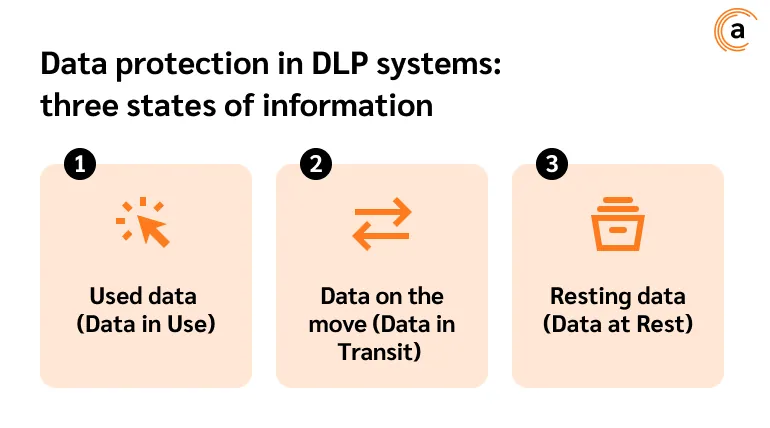
Data protection in DLP systems: three states of information
DLP systems protect information at all stages of its lifecycle, including three key states: used data, data in motion and data at rest.
Used data (Data in Use)
This is information that is actively accessed for enterprise work. Vulnerabilities may occur in the process of reading, updating or deleting it. Inadequate protection of the used data may lead to information leaks or unauthorised access.
Data on the move (Data in Transit)
This type of data moves within a network, between databases or outside the organisation. The main risks are associated with the transfer of sensitive information to private email addresses, cloud storage or through unprotected communication channels. DLP systems prevent such leaks by controlling data flows and blocking unauthorised transfers.
Resting data (Data at Rest)
This is information stored in an archived or inactive state. Such data is less frequently used, but its protection is critical, as compromised storage can lead to the loss of strategically important information. DLP systems provide access control and maximise the security of archived data.
In all three states, information may be confidential - this is data to which access is strictly regulated, and its leakage could have a negative impact on the company's reputation and financial position. These include:
-
employee Personal Data;
-
commercial and state secrets;
-
financial and strategic information.
DLP systems provide comprehensive protection of sensitive information, preventing leaks and regulating access to critical data, which increases the overall level of enterprise security.
Tasks of the DLP system
What are the main tasks that a DLP system solves? In general, we can distinguish two groups of tasks:
- Information Security;
- Economic security.
Ensuring Information Security includes a full cycle of protecting confidential data from any type of risk: leakage, insider trading, inadvertent transfer, damage, misuse, reputational risks, and so on. In DLP systems, the entire turnover of confidential information is fixed and analysed for possible risks to the enterprise.
Economic security is concerned with monitoring and evaluating the network activity of personnel in the workplace to detect the misuse of work time and corporate resources. It also includes preventing potential damage to the company that would occur if confidential data were leaked.
The main benefits of using a DLP system:
-
significant reduction of possible financial losses as a result of leakage of confidential information of the company;
-
identifying misuse of corporate resources by employees;
-
reduction of reputational and image risks associated with information leakage;
-
identification of disloyal employees who may have a negative impact on the company's performance;
-
investigation of information security incidents and identification of information leakage channels;
-
optimisation of business processes in accordance with the identified problems.
Purposes of using DLP systems
The problem of Information Security of a modern enterprise is very acute. Nowadays, the approach to business processes has changed, and there are more infrastructure objects that are used in work but are not directly in the circuit of Information Security and protection. For example, cloud services, remote workplaces, operation of a large number of social networks and messengers and so on. Because of this, information leaks have become more likely and the investigation of Information Security incidents has become a time-consuming and complex process.
The main purpose of using DLP systems in such a case is to prevent any incident of irrelevant use of confidential information regardless of the cause and source of the security threat.
How does a DLP system work?
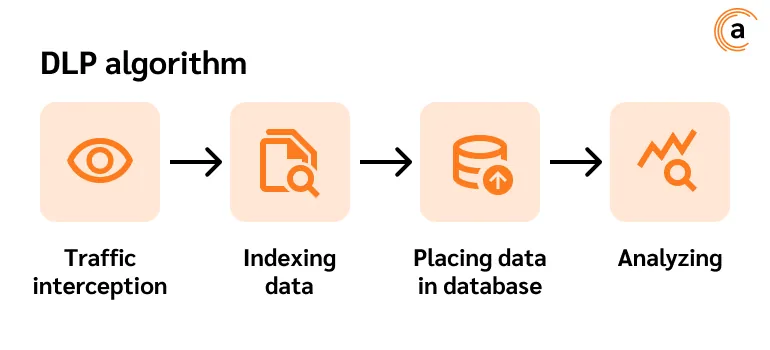
As a rule, the algorithm of DLP systems can be divided into four stages: intercepting and obtaining information, transporting it to a database for storage, indexing the entire data set, and final analysis.
The first stage, intercepting and obtaining information from the maximum number of sources and in the maximum number of formats, according to the one used by the enterprise. The qualitative indicator in this case is that more sources of information are used, and advanced DLP systems can capture information from all major communication channels used by the enterprise:
-
internal and external postal services (MS Outlook, Thunderbird, yahoo.com, gmail.com);
-
transferring files through FTP/FTPS, HTTP/HTTPS, SSL для POP3, SMTP;
-
messenger messages like ICQ, Google Talk, Yahoo! Messenger, Viber, Telegram;
-
database content management PostgreSQL, MySQL, SQLite, Microsoft SQL Server, IBM;
-
print and copy information on local and network printers and scanners;
-
audio, video recordings of the working computer, screenshots from the PC screen.
After interception, the entire data volume is sent to the database (DB) and indexed. Indexing is the assignment of a unique search attribute (index) to a data object to speed up its further search in the database.
The final step is analysis. DLP systems use a variety of ways to analyse intercepted data. And, as in the analogy with the number of sources to intercept, the more diverse the analysis capabilities present in the system, the more extensive and reliable the overall information protection will be. Four types of analyses are most often used: content, attribute, statistical and event analysis. Let's take a closer look.
- Content-based is the analysis of textual content taking into account morphology and transliteration of the language (by words, phrases, phrases).
- Attributive – analyses based on the attributes of media (devices, documents, files).
- Event-based – analysis that is performed when a predetermined event occurs (launching an application, going to a website, attempting to access password-protected information, and so on);
- Statistical – as some volume of events is reached (number of site visits, number of emails transmitted per day, and so on).
How to choose a DLP system?
A few years ago, it was considered that the use of DLP systems was available only for large enterprises. The main argument for their use was scale, complexity in management and organisation of internal corporate processes. But now the opinion has changed. The use of DLP-systems today is conditioned not by the size of the company, but by internal processes of information exchange, the need to ensure a reliable data protection circuit, more frequent cases of leaks and a large number of sources of IS threats. There is a need for flexible, affordable software with great functionality. To choose a DLP system for an enterprise, you need to answer several questions:
How many communication channels do you need to monitor?
The enterprise should determine which communication channels are used during working hours, which of them could be a potential threat to IS, which of them could be a source of inappropriate waste of working hours for the staff.
What tools does the software offer? What analytical capabilities are available?
Is the DLP system limited to information monitoring only or is there also an analytics, response and incident suppression module.
What specifications are required to install security software?
Before installing the DLP system, it is important to ensure that there are no system limitations for this type of software, to find out whether additional hardware or capacity will need to be purchased.
Vendor reliability and quality of communication. Do you need technical support?
Research reliability of the software vendor. What reviews are there about their work and product? Are there licences and certifications to provide such services? Get a presentation of the product and, if available, request a test period of using the software. It's also worth paying attention to feedback from a company. Won't you be left on your own with the new software? Pay attention to how quickly and competently the technical support department works.
Do staff need to be trained beforehand, will there be additional costs to expand staff for software maintenance?
With the help of consultants, assess the scope of the software implementation. In addition to the technical requirements for operation, find out whether there is a need to train security staff to maintain and configure a software, how the existing staff will be trained and backed up, and what the financial and labour costs will be.
And, of course, the cost of the product, taking into account all the needs. How long are you interested in purchasing a licence?
Another important consideration when choosing a DLP system.
Feasibility of purchasing a DLP system
Each company determines the feasibility of purchasing a DLP system for itself. This includes a complex of factors: the need to solve problems with information security, the need to automate protection systems and the work of the security department, the presence of a large amount of confidential, sensitive data that needs to be protected, previous precedents with security, and so on. The cost of software is also an important factor, as well as the number of employees working in the company.
Each of these factors is assessed by the company individually. We can only say that no business can develop without information security today.
What affects the cost of a DLP system
The cost of this type of software may depend on a vendor's model of offering the product: as a single product (for all functionality) or modularly (each vendor determines for itself a priority package of services and pays for it). The cost of a DLP system may also be affected by the period of use included in a software (for the whole time or for a limited period) and the number of related services and support.
The role of DLP systems in business processes
DLP systems are not only a cybersecurity tool, but also a powerful mechanism for optimising business processes. Their main task is to prevent confidential data leaks, which helps minimise reputational and financial risks. However, DLP capabilities are not limited to information protection.
Optimisation of business processes through a DLP system
Safety analyses and process adjustments
DLP systems help to assess the effectiveness of current protection measures, identify vulnerabilities and make adjustments to security policies. This makes them not just a defence tool, but a strategic information security management tool.
Business Communications Archive
To easily work with data archives, the DLP system offers an intuitive interface, advanced search and document review tools. This makes it easier to investigate incidents and analyse vulnerabilities that led to data leaks.
Identifying insider threats
DLP systems monitor a wide range of communication channels, analyse transmitted data and prevent unauthorised leaks of confidential information. They can recognise confidential documents, monitor employee communication and identify potential threats.
Improving the efficiency of the security service
Modern DLP solutions automate enterprise information security control, reducing the burden on security staff. This is helped by the functions:
- configuring flexible security rules to meet the unique needs of each company;
- real-time incident reporting system;
- automated reports and analytical dashboards.
Reputational risk management and employee loyalty control
DLP systems help monitor corporate culture, identify anti-corporate sentiment and minimise the risks of reputational attacks.
Monitoring employee productivity
Security systems allow you to analyse the use of working time, monitor network activity and assess the impact of various resources (social networks, messengers, etc.) on work efficiency.
Modern DLP systems are not just data protection, but a universal tool for managing risks, analysing business processes and improving company efficiency. They provide a comprehensive approach to information security and enable top management to make informed decisions in the areas of HR policy, competitive strategy and resource planning.
DLP systems market
The DLP systems market has received a significant growth boost in recent years. Much of this increased attention has been helped by the global processes that took place in many countries in 2019-2024: the COVID-19 pandemic, the financial crisis, the general digitalisation of the economy and the transition to a mixed or remote working format. The high level of internet penetration, the emergence of dependence of many businesses and individuals on the availability of such a service, and many other things have also had an impact. There is a real need in the market to ensure information security in the presence of multiple sources of threat.
By 2023, the data loss prevention market was already estimated at $3.4 billion. At the same time, according to the experts' forecast, there will be a steady positive growth trend of 20-22% every year. Therefore, by 2028 the market of DLP-systems will reach $8.9 billion. And with the intensification of the service coverage growth up to 25-29% per year in 2030, DLP capitalisation will amount to $31-32.5 billion.
DLP-systems have their products in all regions of the world: North America (USA, Canada), Europe (UK, Germany, France, Italy, Spain, Russia), Asia-Pacific (China, Japan, India, Australia, South Korea), Latin America, Middle East, Africa. Major players in the DLP systems market belong to two countries: the United States (IBM, Palo Alto Networks, Microsoft, McAfee), and Japan (Trend Micro).
Of course, like any product, especially in the software industry, DLP systems have their advantages and disadvantages. Let's take a closer look.
Advantages of DLP systems
-
ensuring a secure loop of accounting and exchange of confidential information at the enterprise;
-
control of employees and their performp./ce;
-
preventing data leaks and responding t;l cybersecurity standards;
-
customisation of digital security rules and responses to meet the company's needs;
-
system as an analytical and reporting tool for information security and analytics.
Disadvantages include
-
disruption of business processes and systems if DLP is not configured correctly;
-
complexity of configuration and management (for some products);
-
additional costs for equipment, cloud storage services.